How long does it take to train an unleveled person up to the point where he can qualify as a soldier, i.e. a combatant ready to be hired by the main character? Let's go find an answer.
Any kind of soldier is considered to be training toward the fighter class, so we can consider the training they do to be the basis of training any 1st level fighter would have received. 500 XP is required to make an unleveled character combat-trained, i.e. capable as a soldier, and then a further 1000 XP is needed to become a 1st-level in any class. (The combat training and XP-before-1st-level concepts are taken from Alexis.)
Just think, a few hours ago I thought I wouldn't work on D&D at all today ... but given my historical percentage of days on which I do work on D&D is, as of today, 95.5 percent (tracked over the last 267 days), I should have realized something would come out of the brainpipe.
I worked, and worked, and got more and more energetic as I added more chunks of code, and the end result is: I've added infrastructure calculations to the world data, including the spread of infrastructure out from each hex.
This short Smithsonian article is about how the skeletons of early Christians were adorned with fabric and gems and venerated as local saints by small churches and monasteries across Europe. Here are some pictures taken from the article:
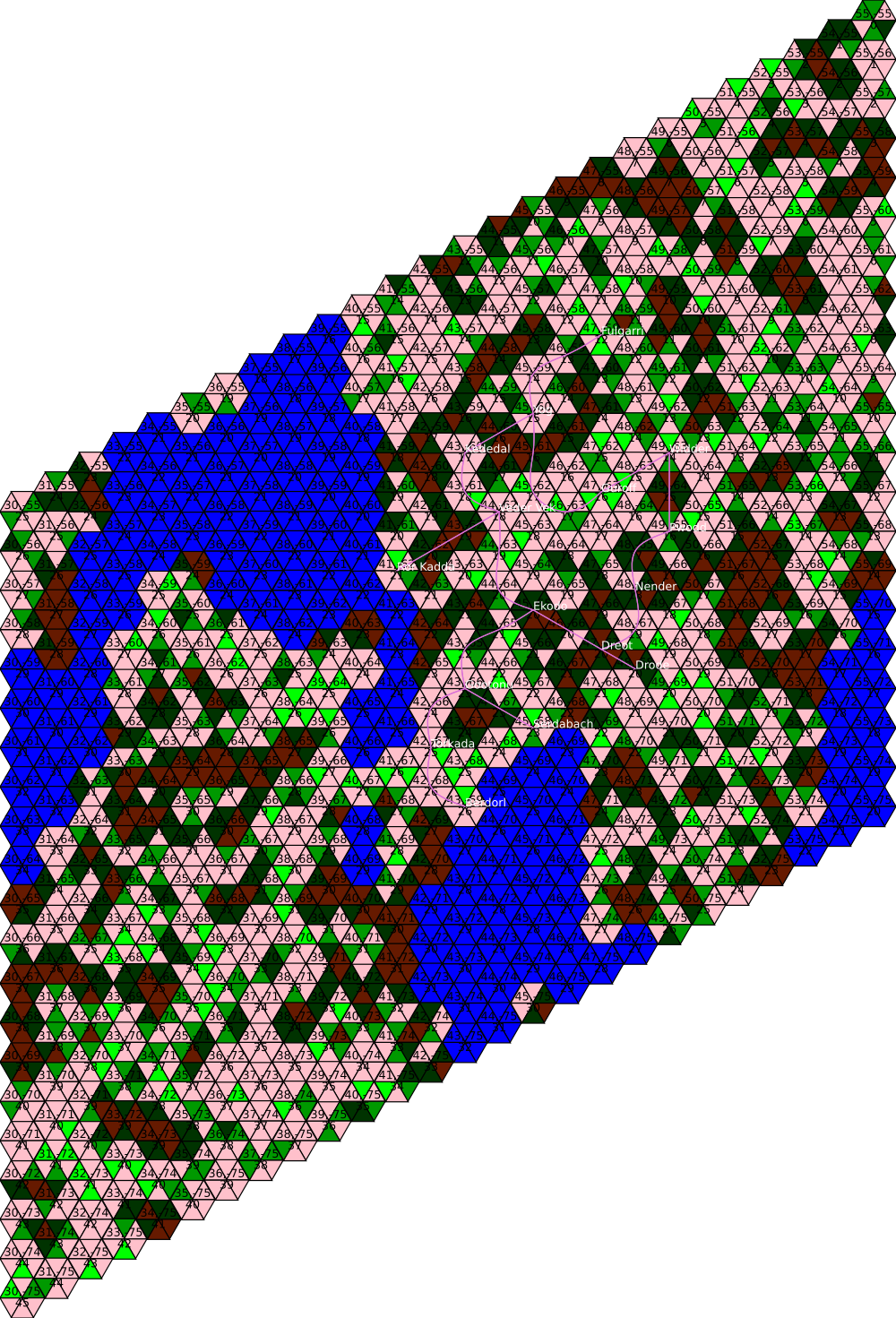
I've been adding to the codebase the expansions I'll need in order to do road and town locations based on triangles. The first chunk of edits I needed to do for that was also just what I needed in order to add something new to the civilized-wild distinction. Have a look at the latest map image; as usual, I recommend opening it in a new tab to see it full size.
Wilderness triangles are now divided into categories 1 through 4; on the map, these are indicated as bright green, olive green, deep forest green, and red-brown. The higher the rating, the more wild and savage that part of the wilderness is. What determines the rating is how many other wild triangles border the given triangle.
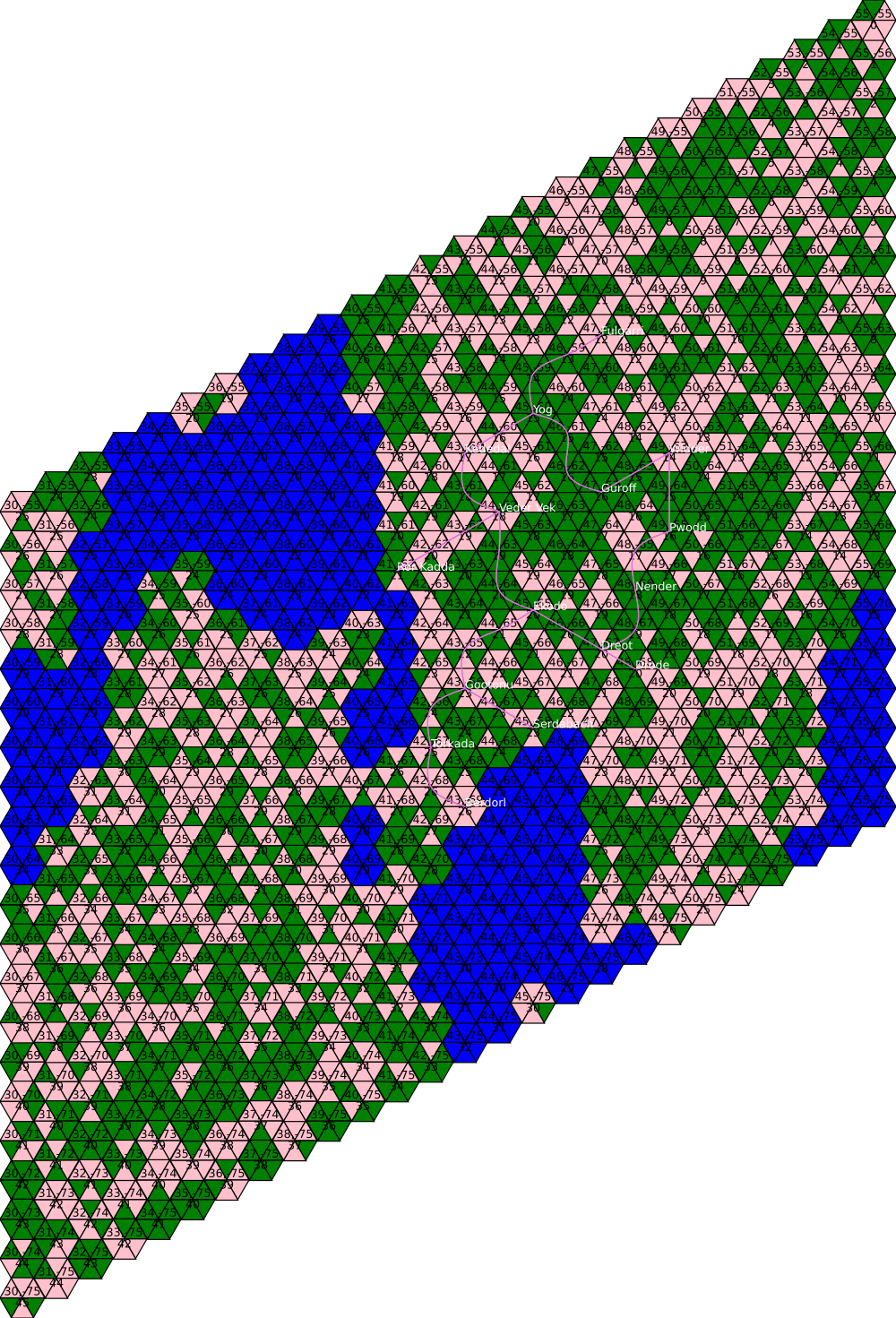
I've successfully added the render layer which displays civilized and wilderness triangles.
I can already see I'm going to have to move some towns around, in order to put them into hexes with all civilized hexes. A sizable town (whether it is a castle town, or a trade town, or a religious site, or whatever) is only considered to be "possible" in a hex which I've determined to be fully civilized -- although in reality it would be the town's presence which made the area "civilized." The reason I have to work backward is because I am choosing to place cities manually; if I wanted, I could go back to random town placement, which I used to do, and have their locations be limited to only (a subset of) type 7 hexes. But I'm not going to do that.
I was going to follow up the last post with an updated map image showing the civilized vs. wild distinction, freshly added to the rendered map. Unfortunately I've gotten stuck on the last 10% of the code, the crucial part which tells the renderer how to color the triangles. It sounds trivial, but owing to the way I've structured the file, it's not as easy as it sounds to simply give them the appropriate color.
No worries, though. This is the kind of hangup where I'll come back over the weekend and instantly see what needs doing. All I need do is let the idea sit untouched for a few days, and I'll think of something. As I said previously, this is not the first attempt at the triangle maker, it's just the first successful one after a few months: so what's another day or two?
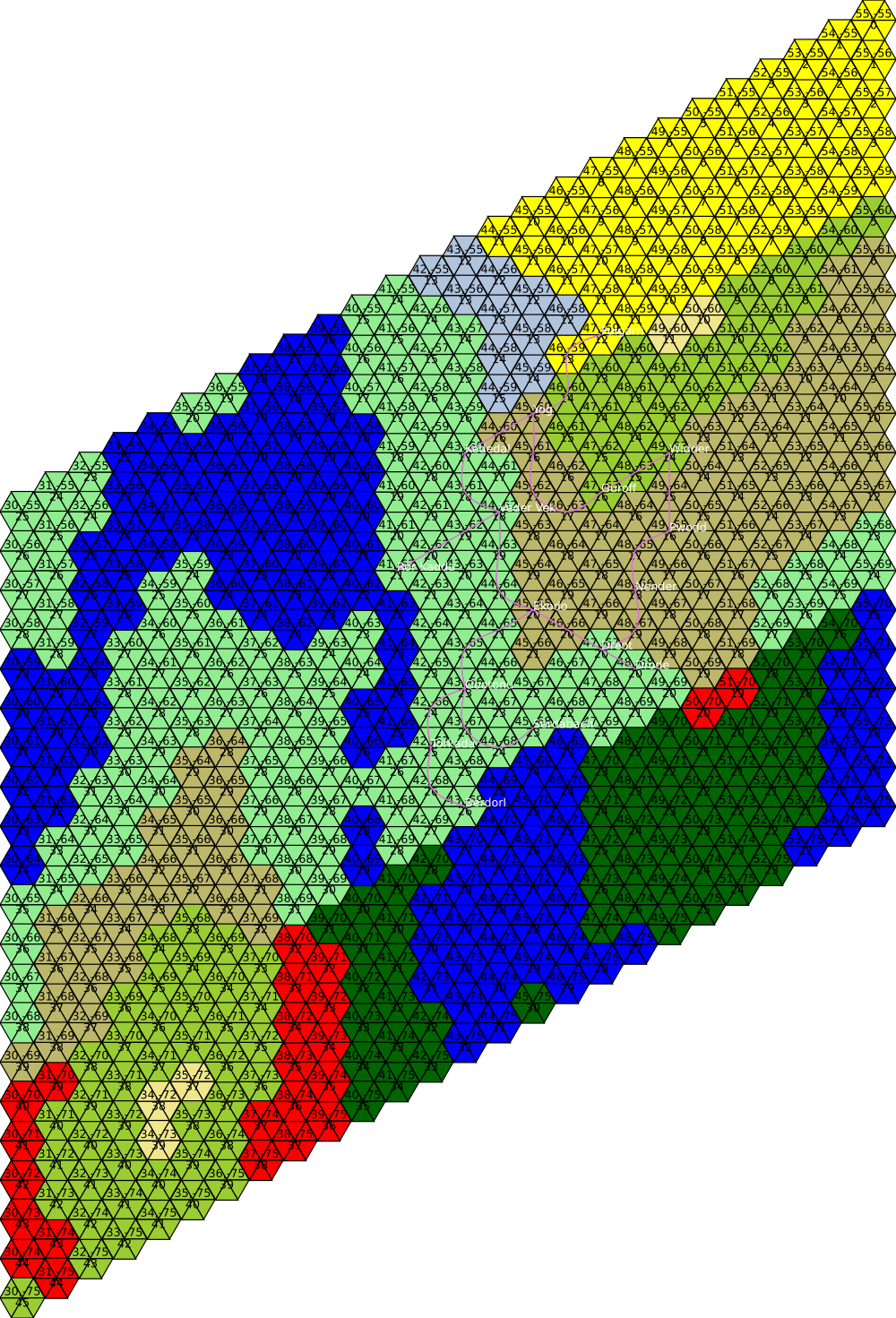
Today I bring you a discussion about this map, which shows the same section of my world as this post, but with the newest addition I've been working on this week:
If you can't see it right now, here's what I've done: I've subdivided each of my game world hexes into triangles. Six equal triangles. This is a stepping stone toward greater detail and variation in the design of my world. I could go on from here to have intra-hex elevation or climate variation, rework the distance algorithm for resource pricing to get more exact numbers, or do something else entirely.
First off, I want to share the new and improved design of my trade table. Before, when the table existed only as output on a computer terminal, it was difficult to get the monospaced font and rigid layout to play nice with a file viewer or printer. As you can see below, I've given it a new look, which not only makes it easier to read, but also has made it very easy for me to print off. In addition, since last time I've added a "units" column for those items which require a measurement other than their weight.
The ultimate form of D&D is a copy of the real world in which the DM has a control panel and can manipulate any feature of the world, or indeed the universe. Furthermore, the world's history would be completely rewindable, so that you could go back to any earlier point in the simulation, make tweaks, and rerun things to see how the world turn out at some later date. Alernatively, you could effect a change in the world's "ruleset," but only apply it going forward; for example, on July 7th, 2016, gravity suddenly changes to 9/10th normal, and all preexisting activity and artifice must react to this change in physical law. (Imagine the effects on planetary orbits and their calculations, space travel, buildings, the tides, wind power, and a million other things.)
The first part in the series can be found here. I'll assume throughout that you've read it, but please ask if anything is unclear -- it's easy for me to forget whether or not I've talked about this or that part of the whole system.
Today I'll finish talking about roads, then give a brief overview of the environmental data I'm using in my world, and how it's generated.
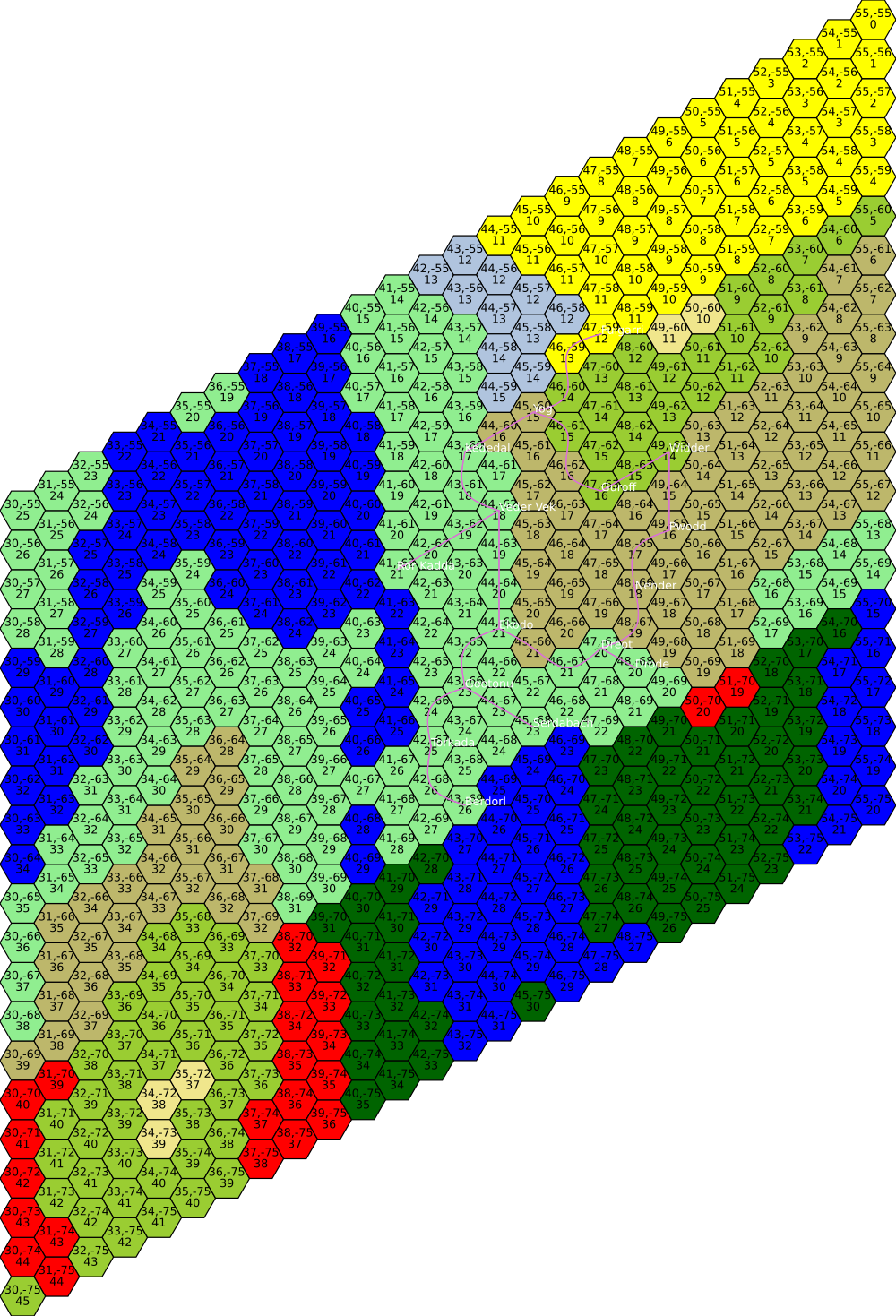
I hope one day to run a world based on the Earth, but I'm not rushing to get there, just building one piece of the game rules (and tools for running it) at a time. In the meantime, I have a small fantasy world that I've put together as a place holder, which I can certainly use with no problems. Here is a picture of a small chunk of it. The scale is 20 miles (face to face) per hex. The text may be a little hard to read due to the conversion program: sorry about that.
Progress on D&D projects, for me, is all about chipping away here and there. Flit over to the price table and do some calculations; alight upon the old rulebooks and rewrite a few spells in my own wording and with clarifications I deem necesary; review my "half-finished idea" folder and see whether any new thoughts are keen to join some old ones.
One of the things I'm working on is my own version of the knowledge skill (or "sage" skill) system which Alexis has invented for his game. In short, sage skills are a way of quantifying knowledge about the game world and giving it over to the players as CERTAINTIES, things which they are guaranteed to know and which they can act on.
Originally I was going to make my first post an "about me" kind of thing. Who I am, where my D&D influences come from, and so on.
But that's a little too much like the college classes which required one to sit through a tour of the syllabus on the first day. So forget that: let's dive into content.
Three weeks ago, I reached a milestone on one of my D&D projects: the economic system. That milestone was the first successful end-to-end calculation, from town and geography info all the way through to getting the price a player pays for a particular product, based on its local availability and the local availability of the kind of artisan which makes that product.