I was initially interested because it had Robert Redford and Paul Newman co-starring; having just watched Butch Cassidy and the Sundance Kid for the first time, I was eager for more from that pair. I didn't feel so strongly about Butch Cassidy that I wanted to follow its director to this film, but then my decision was clinched when I saw on Wikipedia that The Sting's plot took inspiration from David Maurer's book The Big Con, which I read just a few months ago.
My initial interest in watching this came from the costars: I figured I couldn't go wrong with Robert Redford and Paul Newman together. But I also watched it because the university movie theater in my new town (Madison, WI) is going to be playing a bunch of classic movies over the next few months, including Sam Peckinpah Westerns. In their online blurb for Peckinpah's The Wild Bunch, the movie theater people explicitly contrasted that movie's blood and grit with Butch Cassidy's freeze-frame, doomed-but-heroic ending. They further suggested that anyone who hadn't seen Butch Cassidy should watch it to get an idea of what "ordinary" Westerns were like in 1969, to more properly appreciate the contrast presented by a revisionist Western like The Wild Bunch that came out the same year.
For the first half of the 17th century and then some, Morocco was in a pretty dismal state. Here's my game world wiki writeup about what was going on there:
I watched this as part of my "curriculum" for movies featuring intrigue. Although I've given this a star rating, as with previous entries this is less a review and more an analysis of character interactions to improve my D&D Dungeon Mastering skills.
The idea of watching movies to study intrigue was inspired by this Tao of D&D post, and subsequent discussion on Alexis Smolensk's Patreon. As always, if you care about the cutting edge of roleplaying games, you need to read Alexis's blog. Once you see how much you can learn from the millions of words he's given away for free, you'll understand why I send him some cold hard cash each month to get just a little extra.
A coincidence involving a book club led me to make the acquaintance of David McEnulty, one of the two people working on Convoke, an RPG support application which has just entered (very early) beta testing. McEnulty said he'd read my master's thesis and wanted to get my opinion of his app. We had a pleasant video call that lasted almost three hours. I've already privately given him feedback on design, functionality, and marketing aspects of the tool. Below, I explain what it is and assess how applicable it seems to be for the average DM.
What Convoke Is
Convoke is an RPG support application designed to let the DM and players carry out certain parts of gameplay in between a typical group's regularly-scheduled game sessions. DM-facing functionality includes:
I've invented a new exercise to work on my ability to imagine what each and every NPC in a D&D setting might be thinking, and to strengthen my powers of description.
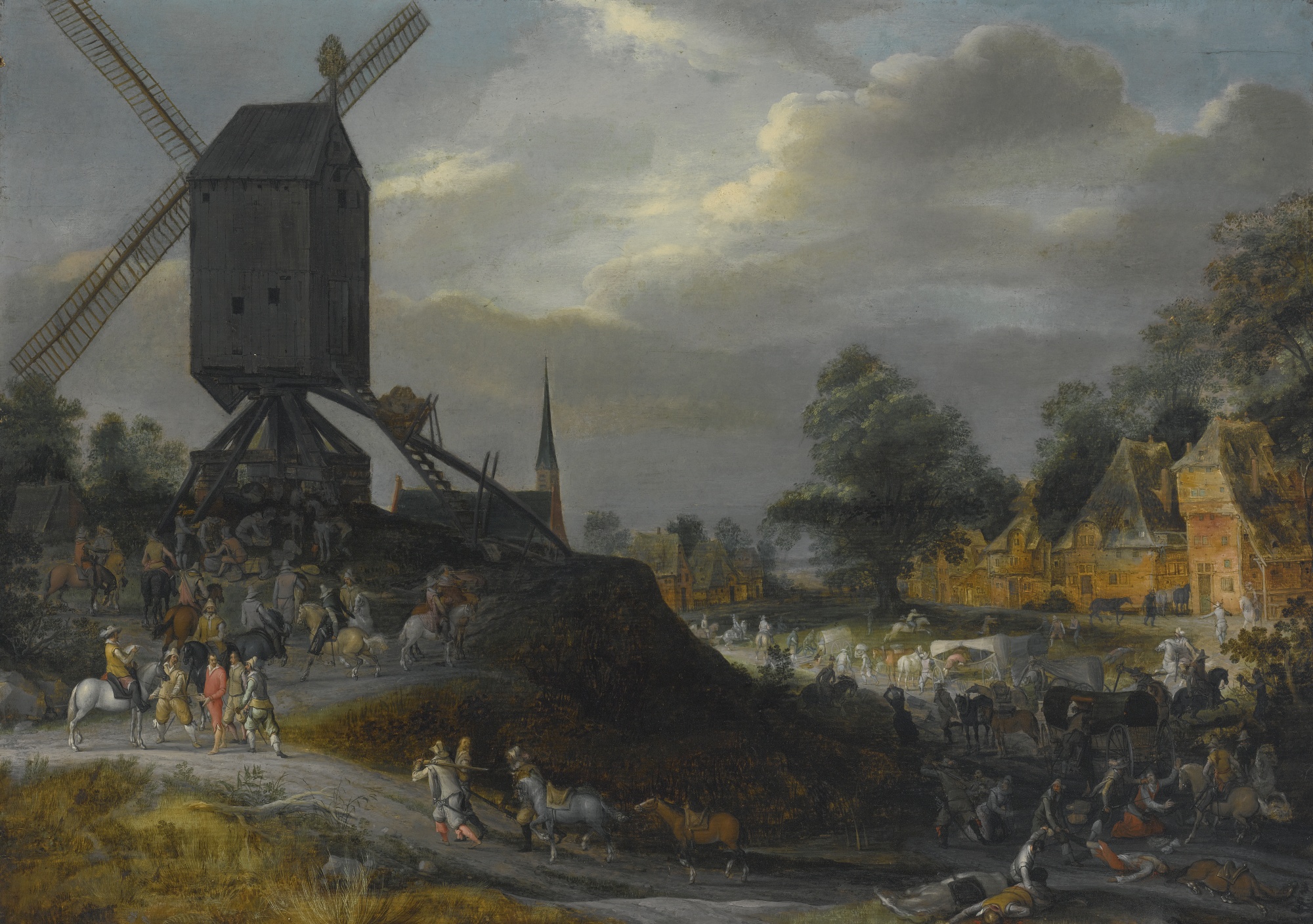
Here we have Pieter Meulener's painting Sack of a Flemish Village by Spanish Soldiers, painted circa 1654. (Sorry the quality isn't great when zoomed in; it's the best version I could find.)
Now, look at these closeups, where I've labeled several people with numbers. In this post, I've imagined snippets of those characters' thoughts, speech, and/or actions, which befit the events of this painting, and the battle that preceded them.
Alexis has weighed in with high and generous praise for 2d6 Taoists:
[T]hese writers have worked diligently and well to create works that deserve recognition in their own right ... I feel overwhelmed at the prospect of examining their work here, as I don't believe that I can do it the justice that it deserves.
I give it my full endorsement; if my work is worth reading, then so too is the work that these designers and writers have done. Trust the effort, trust the value it offers; it is a small but meaningful tome that is worth reading more than once.
Alexis has been writing a new series about dungeon mastering, one post of which was about how to effectively incorporate intrigue into your game. Alexis has a seemingly encyclopedic knowledge of film, and has often suggested ways for DMs to improve their craft by studying movies (such as in this post). After he broached the subject of intrigue, in his Patreon subscriber chatroom I asked what movies a DM should watch to improve his understanding of intrigue. He gave me the following list (alphabetized, sans "a"/"the").
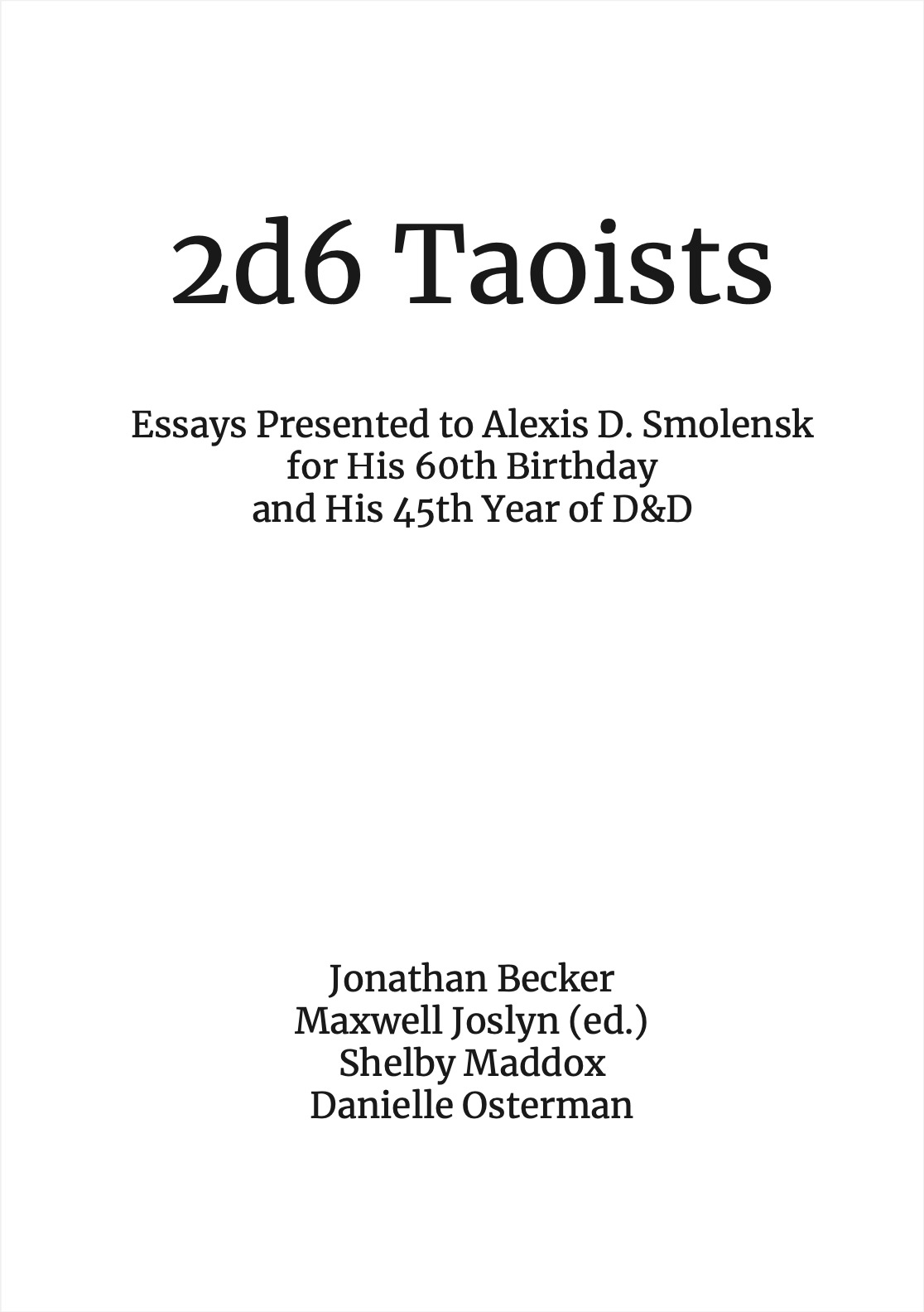
2d6 Taoists, a collection of essays honoring the work of Alexis Smolensk, is now available for purchase. Here's part of the description from the purchase page:
In this volume, four tabletop RPG designers pay homage to Smolensk's influence and talent with essays inspired by facets of his work. Jonathan Becker shares how a change in perspective renewed his devotion to the art of the RPG. Maxwell Joslyn explains why developing RPG-specific software applications is the best path toward expanding RPGs' depth and complexity. Shelby Maddox presents methods for developing game rules and game settings which feel coherent and organic. And Danielle Osterman, after empirically examining YouTube videos and Smolensk's blog posts, makes the case for improving how we teach and train budding DMs.
I can actually derive a certain hopefulness from the game being so unusual, in a way that tempts DMs to give up on rules. Despite D&D having been around for half a century, so little work has been done to truly push its boundaries. However, that means those of us who do work to improve our games should be optimistic that with sufficient time spent striving and searching, we will break through to one frontier or another, and discover new and precious knowledge about how to improve the functioning of the game. The field is wiiiiide open.
Hi, MatthewDailey. Couldn't find your email so I'm contacting you here.
I don't recall how I found you and your projects -- probably HackerNews -- but I was intrigued by your GPT DND. You aren't the first to do "AI as Dungeon Master", but you are the first I've seen to add voice to the equation, so kudos.
I thought you might be interested in my gm-trainer project, which comes at things from the other direction: using LLMs as pseudo-players, rather than the GM, to provide GMs with a sort of training sandbox. Still early days, and not as configurable as I'd like it to be for other people. But to my knowledge I'm the first to flip things around like that. (Which makes sense if we consider that most people working in the nascent "AI + RPG" space seem to want to replace the "scarce resource" that is GMs/DMs).
Nothing to apologize for, brother. I wasn't trying to goad you into writing: when I have something to say, I say it, that's all. (For which you have ass oil to thank; the rest of my comment grew after that.)
No need to rush the thesis; it's ~200 pages after all. Take it piece by piece; if you have questions, email me -- or better yet, write 'em up here and we can do the whole public convo thing.
I am fond of Elves and Dwarves and Halflings, but I don’t often find they really “fit” into the worlds I make.
I have chronic hand pain. Not as debilitating as the medical problems you have faced, but I understand a little of your struggles — one against the flesh and one against the medical system, if your history’s anything like mine. However yesterday went or tomorrow goes, I hope you’re OKish today.
What beavers are for you, birds are for me. They, too, cover themselves in ass oil as a sealant — perhaps the two kinds of animal are in cahoots. Now there’s a wacky hook. And you’ve inspired me to consider giant birds in my world. The Atlas Mountains seem like a good place for a roc, and with such a big wingspan they could range far for their dinner. Maybe even menace Spanish shipping, Moroccan traders or Salian pirates — but the risk / reward ratio would be poor. Better to snarf a cow.
I created this partial map of the Canary Islands for my D&D game, which is set in a mostly-historical version of the real world circa 1650.
I'm planning to take the app/website/wiki that I built for use at my game table and upload that to the public web pretty soon. Until July, it served just fine as an app running on my home network, with the players and I logging into during gameplay. But we are now all geographically separated, and hoping to continue playing remotely.
Joel, I heard of your blog through Tao of D&D, and subscribed after reading "Space is Big...". Everything I've read since then has confirmed that that was a wise decision.
First of all, I like your style. Sarcastic but informed. Angry but not ranty. When you don't like something, you say so and you say why, and then you offer something better.