Recently I had the opportunity to play for a few weeks in an online D&D campaign. Playing D&D over the internet really got me thinking about how we can use computers to do more of the heavy lifting for player and DM alike.
Functionality
Programs, apps, webpages: whatever the ultimate shape of the infrastructure, it should be able to facilitate the following broad functions:
view and manipulate digital character sheets, including changing one's equipment, making notes, and writing descriptions.
review information about the game world, such as geography, roads, weather, the current market prices if they're at a city, and so on.
My game is on hiatus until the new year, give or take, as the holidays descend upon us and we all scatter to visit our families. I'm still in school, although classes themselves are over: finals are next week and the deadline for the first chunk of my thesis is in a week's time.
The other day, in between work on my thesis and my classwork, I made time for some D&D work. Apart from futzing with rules for light and illumination (still rough), I reworked my drunkenness table (based on Alexis's post here) so that it is much easier to use.
Here is the more-polished half of my current notes for the assassin skill, Impersonation. I have had a good burst of assassin-related ideas recently.
Impersonation
Impersonation is pretending to be someone you are not, whether subtly (through your speech and your motions) or overtly (through your appearance and your skills).
Core Ideas
The further removed you are from the target, the harder it is to impersonate them.
The further removed an observer is from the target, the more likely they are to take your disguised self as genuine.
If you spend time in proximity to an observer who is suspicious of you, they will periodically make checks to see if they become more suspicious of you. If they fail these checks, their suspicion will lessen, and the periods between checks will grow greater, until eventually they are no longer suspicious.
I need some help with aspects of my economic system related to metals and the manufacture of metal goods.
For example, I want to figure out more accurate values for the amount of coal needed to produce enough heat to melt metals for smelting.
I can find values online for the BTU produced by a given unit of a given type of fuel. And I can find the melting points of various metals and metal alloys.
But how many BTU are needed to reach a given temperature in a forge's hearth, and how long does that temp need to be maintained? People who burn coal to heat their homes have created online calculators to estimate how much coal would be needed to keep a room of a given size heated to a given temperature, but their answers don't agree with each other in the slightest.
In our most recent session this past Sunday, the party met and drank with a local merchant who they'd met on the road, and agreed to sign a contract with him the next day (a contract to do something dangerous to benefit his business -- I'll skip it for now.) The same evening, though, they got to scheming: suppose they were to go and find this guy at home tomorrow morning, while hungover, and just take him out? That way they could earn the money he was going to pay them without having to do anything more dangerous than killing one small-time merchant.
In this New York Times article about the desertification of Northern China, there are some great drone-camera videos of the landscape. The article is light reading and the imagery is top notch. Have a look.
Got it?
As the players have decided to undergo a journey of perhaps a hundred miles to return an old man to his hometown, I've taken a stab recently at the roughest, crudest possible first version of my own wilderness/travel damage system (as originally conceived by commenter Zzarchov, and implemented by Alexis here and elsewhere, and discussed here too.) Thus I find this kind of material inspiring. Traveling from place to place should not be a cakewalk for the characters. It should sap their energy and wear them down so that that every roadside inn, oasis, fellow traveler sharing food, or friendly forest creature is a boon.
As I go along I am starting to think that the knowledge skill system has more potential than the (admittedly massive) task of defining exactly what information the player character knows about the world, and exactly what capabilities the character has as choices for maneuvering and manipulating in the game world.
I think the knowledge skills could also serve to define the knowledgeability of a society. And this could, for starters, be based on the Intelligence (or other scores) of the society's inhabitants.
I watched plenty of animated movies as a kid, but only one has stuck with me for years and years: The Thief and the Cobbler. It wasn't a Disney movie, it wasn't any big-picture studio -- I always had the vague idea it was some small British outfit -- and it was totally surreal and artistic and unlike the other movies I was exposed to as a child.
Today, while talking with my friend Caroline who is heavily into animation, I learned that the version of the film released on video, as I saw it, was a cobbled-together, big-studio-driven money-recouping edit of a piece of handmade animation art that one guy worked on for years.
First off: this isn't an apology post. Here's something a bit substantial which I tackled lately: the rules for handling the creation of undead. They're not complete but the concepts are there.
Most of the work I've done on D&D in September is just adding miscellaneous rules the website -- and I've barely even been doing that for the last couple weeks. Things aren't hectic at school, and my free time hasn't decreased too badly, but what's happened is that my spare mental energy has gone down. And I've been running a game again for five or six weeks now, after not actively DMing for three years.
At the last session, I asked for help remembering all the rules topics which had shown, in the course of the night, to need expansion. I know my players are great, because they immediately helped me out. Therefore I know they're concerned with precedent and with building the rules, which means they are going to care about the game, which means they are going to make me sweat to keep up with them.
Things are a bit busy for me as school picks up, but I have begun running D&D again and I dare say it's going well. Two sessions so far. I have a few players, friends all, who I think will show up to all or most sessions, and they have friends who they want to bring in on the fun, so clearly I'm doing something right.
Most of my D&D work as of late has been plugging away at the website. In particular I've begun adding my own conception of knowledge skills to the appropriate character classes. The Poisoning and Subterfuge skills have not been posted on this blog, so go take a look!
Well, as of now, my website is live. It's going to be a place where I put allllllll my rules documents, nicely formatted and hyperlinked so that both the players and I can easily access them during the game. There's no easy way to keep the rules all in my computer and still actually use them.
I'll be transferring them from the plain format text I've been using to the format which my programs turn into a webpage, one by one.
I tackled the subject of training non-leveled individuals a few times recently, and having gotten some feedback from Alexis, I believe I've arrived at a useable version which can serve as a good foundation for future improvement. At any rate I'm going to set them aside at the moment, and focus on another little project which I'll be posting here very soon. Stay tuned for that, and in the meantime, here are the Training and Instruction rules as I'm going to use them for now:
Training is the process by which a leveled trainer teaches an unleveled person, called a trainee. By this process, the trainee literally gains experience, and thus XP, over time. Through this XP gain, the trainee can eventually count as combat-trained, or even reach 1st level in the trainer's character class.
Here I'll continue to talk about training non-leveled persons to 1st level, as I have been discussing these past few days. Let me remind you that when I say "training," I'm not talking about gaining levels, I'm talking about gaining actual experience (as well as the quantified version, experience points) for the purpose of becoming a 1st level character.
Alexis brings up the point that just rolling a die for the number of years necessary for training isn't enough. Training has to be less cut and dry than that, and it has to include the possibility of failure.
Today I'll try to define some potential outcomes of the training process talk about the potential outcomes of the training process. Consider the following continuum of results, arranged from worst to best:
Alexis left a comment on my post about training soldiers, asking how I'd handle the party training one lone individual instead of a group of them. Here's what he had to say:
"I can see the logic here - particularly in establishing a minimum time. I find I want some sort of random roll, however, based on a person's temperament, ability, intelligence, failure to get his or her self injured, etc. The above seems a bit, well, pat for me. It works for mass armies - but supposing the players pick up a lone, non-combat trained person in their travels, who wants to become an adventurer - say, a 15 year old boy. How would the system deal with that?"
Lately I've been playing with rules for Alchemy, a knowledge specialty accessible to mages, and maybe druids too. I haven't decided on that. I'm still on the fence over whether classes will share any trees. Thief/assassin, druid/ranger, paladin/cleric, fighter/other fighter-types, mage/cleric: all of these pairings might conceivably share one or more skill trees.
OK, no more preamble. Here's what I have so far. None of this is written in stone of course -- tear it apart, please. I wish I had a tree-like visualization for you, but not yet.
How long does it take to train an unleveled person up to the point where he can qualify as a soldier, i.e. a combatant ready to be hired by the main character? Let's go find an answer.
Any kind of soldier is considered to be training toward the fighter class, so we can consider the training they do to be the basis of training any 1st level fighter would have received. 500 XP is required to make an unleveled character combat-trained, i.e. capable as a soldier, and then a further 1000 XP is needed to become a 1st-level in any class. (The combat training and XP-before-1st-level concepts are taken from Alexis.)
Just think, a few hours ago I thought I wouldn't work on D&D at all today ... but given my historical percentage of days on which I do work on D&D is, as of today, 95.5 percent (tracked over the last 267 days), I should have realized something would come out of the brainpipe.
I worked, and worked, and got more and more energetic as I added more chunks of code, and the end result is: I've added infrastructure calculations to the world data, including the spread of infrastructure out from each hex.
This short Smithsonian article is about how the skeletons of early Christians were adorned with fabric and gems and venerated as local saints by small churches and monasteries across Europe. Here are some pictures taken from the article:
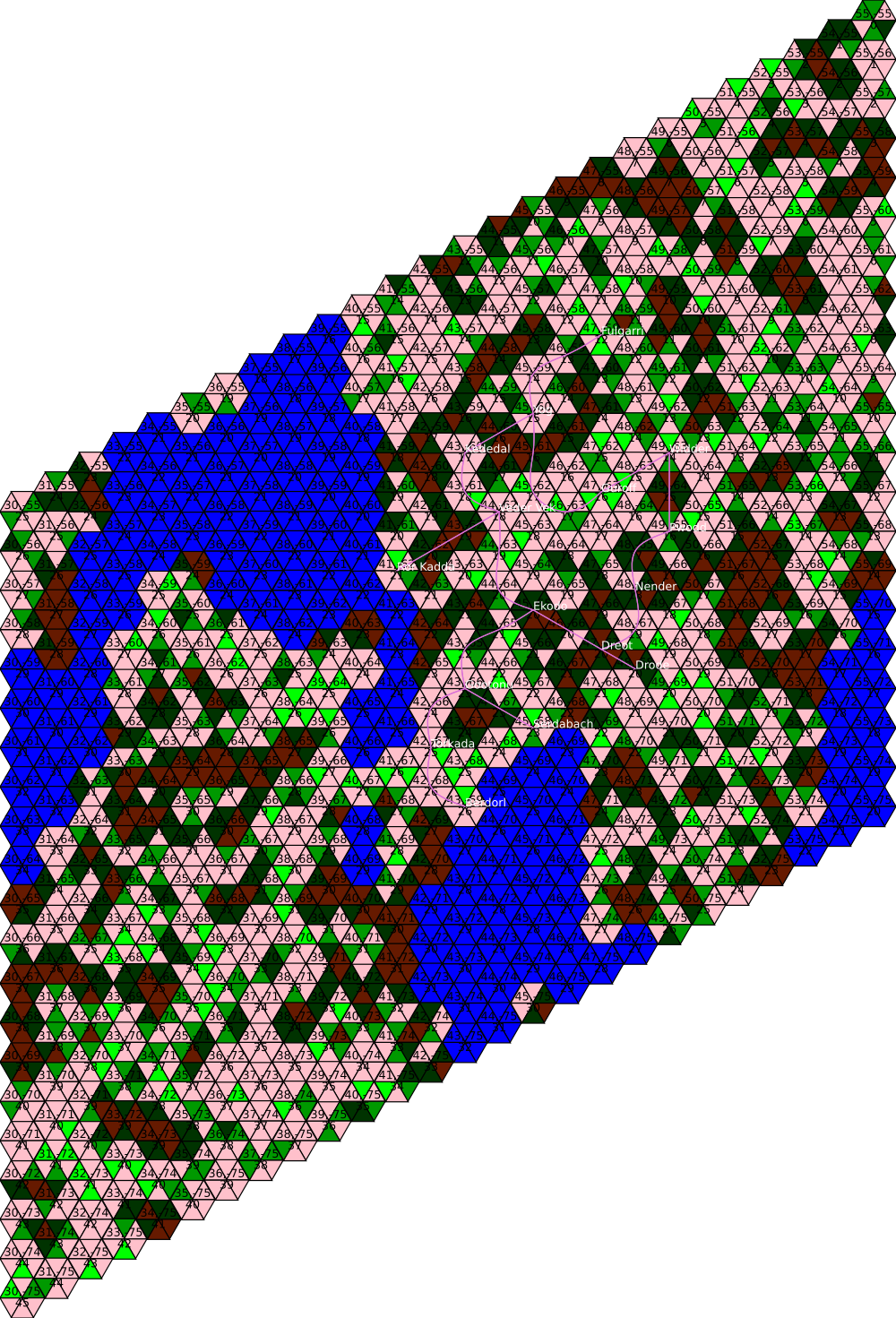
I've been adding to the codebase the expansions I'll need in order to do road and town locations based on triangles. The first chunk of edits I needed to do for that was also just what I needed in order to add something new to the civilized-wild distinction. Have a look at the latest map image; as usual, I recommend opening it in a new tab to see it full size.
Wilderness triangles are now divided into categories 1 through 4; on the map, these are indicated as bright green, olive green, deep forest green, and red-brown. The higher the rating, the more wild and savage that part of the wilderness is. What determines the rating is how many other wild triangles border the given triangle.
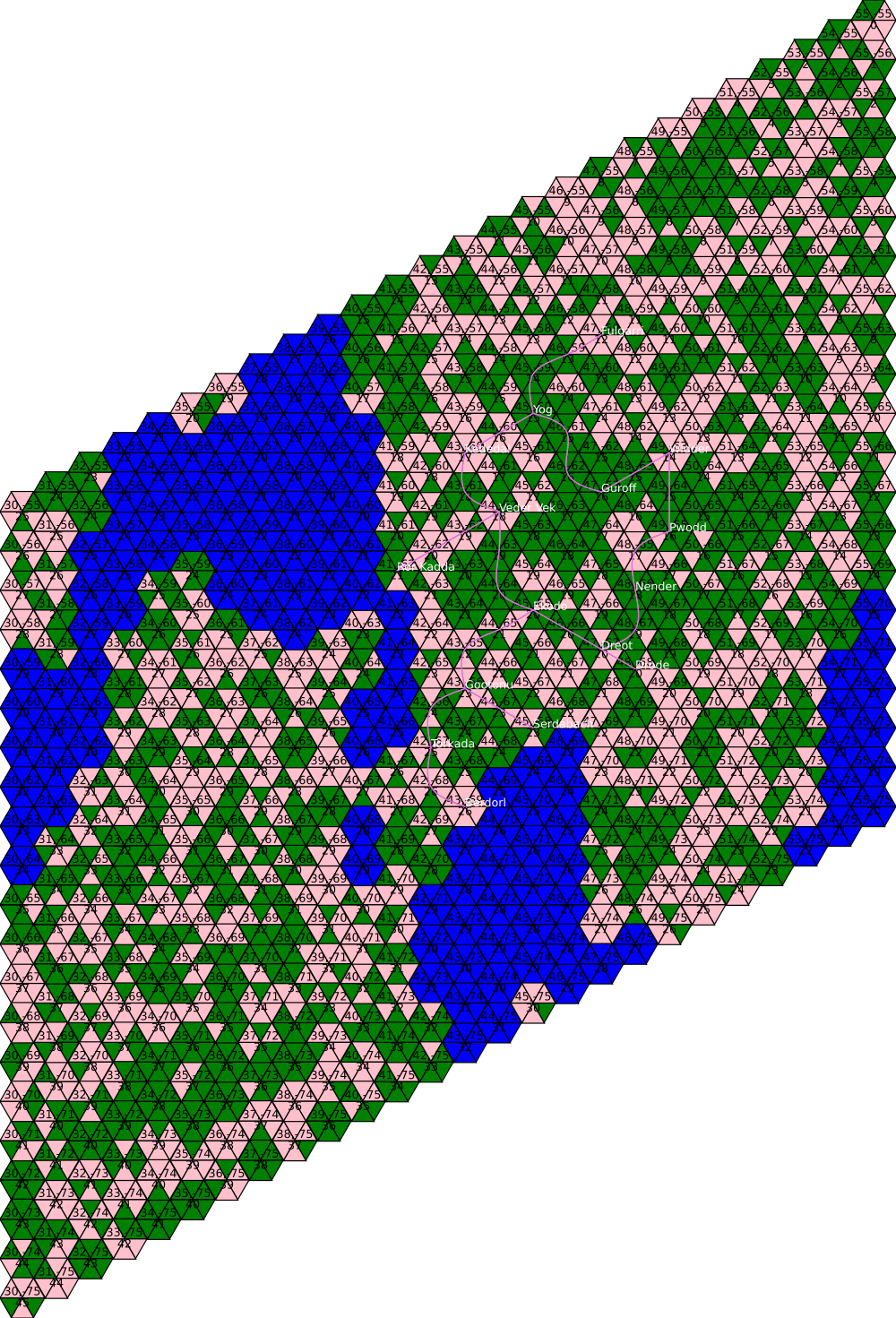
I've successfully added the render layer which displays civilized and wilderness triangles.
I can already see I'm going to have to move some towns around, in order to put them into hexes with all civilized hexes. A sizable town (whether it is a castle town, or a trade town, or a religious site, or whatever) is only considered to be "possible" in a hex which I've determined to be fully civilized -- although in reality it would be the town's presence which made the area "civilized." The reason I have to work backward is because I am choosing to place cities manually; if I wanted, I could go back to random town placement, which I used to do, and have their locations be limited to only (a subset of) type 7 hexes. But I'm not going to do that.
I was going to follow up the last post with an updated map image showing the civilized vs. wild distinction, freshly added to the rendered map. Unfortunately I've gotten stuck on the last 10% of the code, the crucial part which tells the renderer how to color the triangles. It sounds trivial, but owing to the way I've structured the file, it's not as easy as it sounds to simply give them the appropriate color.
No worries, though. This is the kind of hangup where I'll come back over the weekend and instantly see what needs doing. All I need do is let the idea sit untouched for a few days, and I'll think of something. As I said previously, this is not the first attempt at the triangle maker, it's just the first successful one after a few months: so what's another day or two?
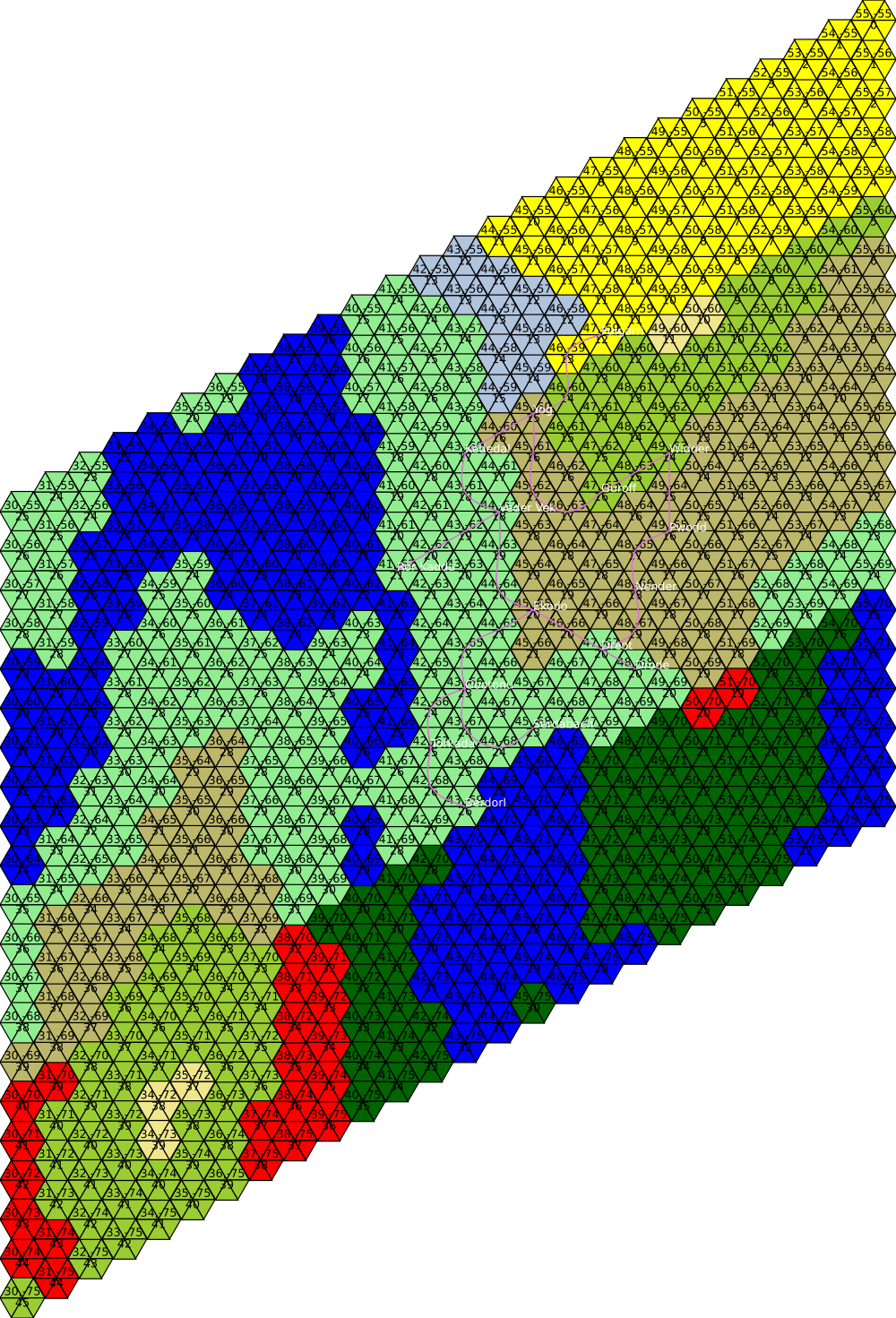
Today I bring you a discussion about this map, which shows the same section of my world as this post, but with the newest addition I've been working on this week:
If you can't see it right now, here's what I've done: I've subdivided each of my game world hexes into triangles. Six equal triangles. This is a stepping stone toward greater detail and variation in the design of my world. I could go on from here to have intra-hex elevation or climate variation, rework the distance algorithm for resource pricing to get more exact numbers, or do something else entirely.
First off, I want to share the new and improved design of my trade table. Before, when the table existed only as output on a computer terminal, it was difficult to get the monospaced font and rigid layout to play nice with a file viewer or printer. As you can see below, I've given it a new look, which not only makes it easier to read, but also has made it very easy for me to print off. In addition, since last time I've added a "units" column for those items which require a measurement other than their weight.
The ultimate form of D&D is a copy of the real world in which the DM has a control panel and can manipulate any feature of the world, or indeed the universe. Furthermore, the world's history would be completely rewindable, so that you could go back to any earlier point in the simulation, make tweaks, and rerun things to see how the world turn out at some later date. Alernatively, you could effect a change in the world's "ruleset," but only apply it going forward; for example, on July 7th, 2016, gravity suddenly changes to 9/10th normal, and all preexisting activity and artifice must react to this change in physical law. (Imagine the effects on planetary orbits and their calculations, space travel, buildings, the tides, wind power, and a million other things.)
The first part in the series can be found here. I'll assume throughout that you've read it, but please ask if anything is unclear -- it's easy for me to forget whether or not I've talked about this or that part of the whole system.
Today I'll finish talking about roads, then give a brief overview of the environmental data I'm using in my world, and how it's generated.
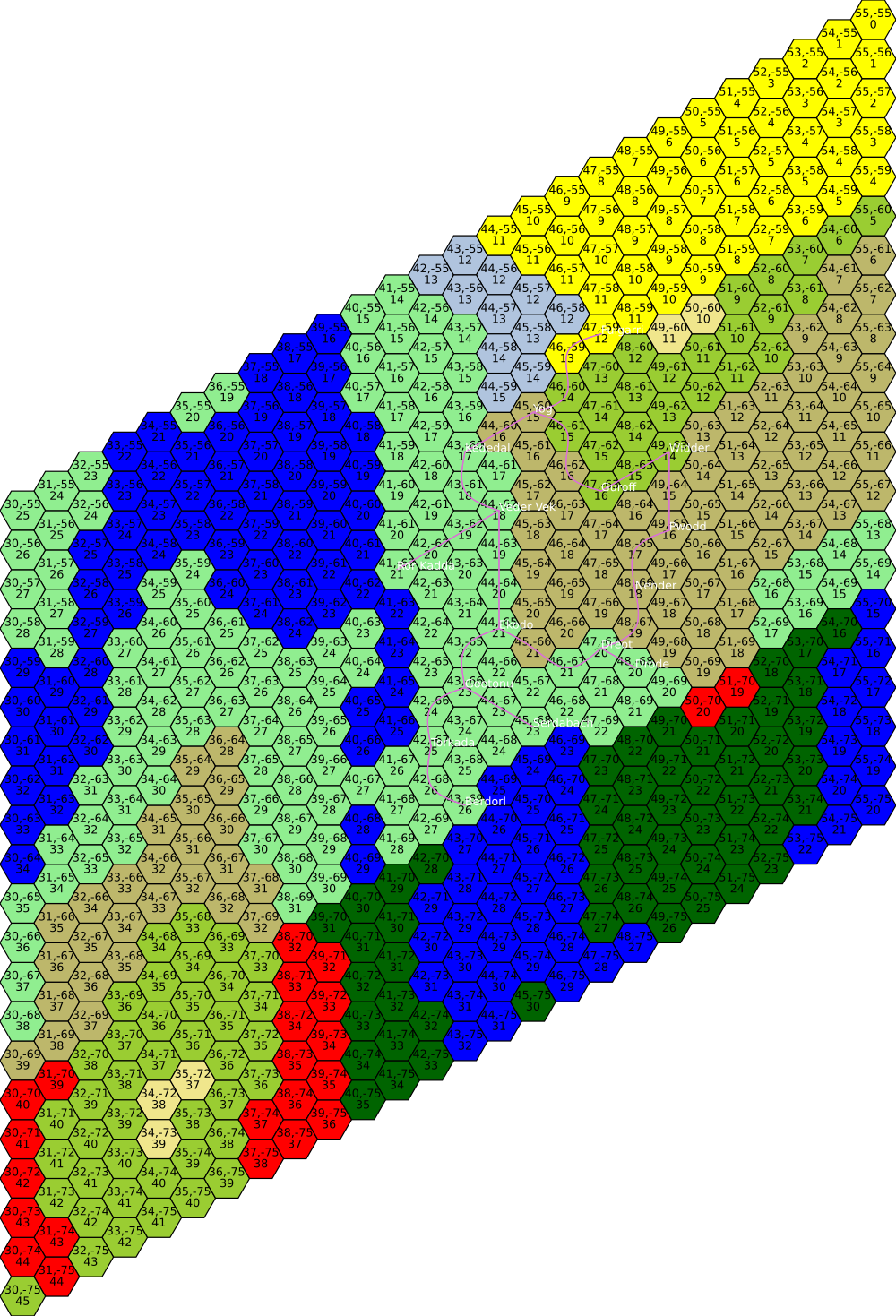
I hope one day to run a world based on the Earth, but I'm not rushing to get there, just building one piece of the game rules (and tools for running it) at a time. In the meantime, I have a small fantasy world that I've put together as a place holder, which I can certainly use with no problems. Here is a picture of a small chunk of it. The scale is 20 miles (face to face) per hex. The text may be a little hard to read due to the conversion program: sorry about that.
Progress on D&D projects, for me, is all about chipping away here and there. Flit over to the price table and do some calculations; alight upon the old rulebooks and rewrite a few spells in my own wording and with clarifications I deem necesary; review my "half-finished idea" folder and see whether any new thoughts are keen to join some old ones.
One of the things I'm working on is my own version of the knowledge skill (or "sage" skill) system which Alexis has invented for his game. In short, sage skills are a way of quantifying knowledge about the game world and giving it over to the players as CERTAINTIES, things which they are guaranteed to know and which they can act on.
Originally I was going to make my first post an "about me" kind of thing. Who I am, where my D&D influences come from, and so on.
But that's a little too much like the college classes which required one to sit through a tour of the syllabus on the first day. So forget that: let's dive into content.
Three weeks ago, I reached a milestone on one of my D&D projects: the economic system. That milestone was the first successful end-to-end calculation, from town and geography info all the way through to getting the price a player pays for a particular product, based on its local availability and the local availability of the kind of artisan which makes that product.