Review of Project Hail Mary


15 posts · See All Tags
That's right, drongos: a new interview awaits your hungry eyes and brains.
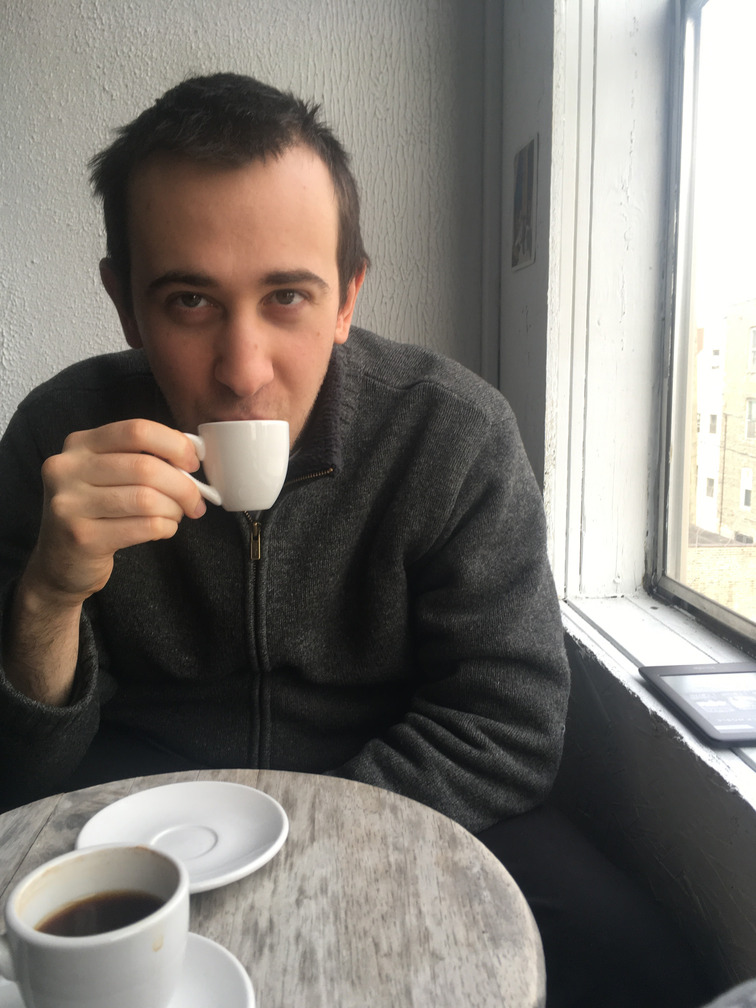
The Drongo: Our guest today on The Drongo is Alexi Caracotsios, a man of countless talents. Readers, prepare yourselves: here he comes.
What are you all about, Alexi?
Alexi Caracotsios: I have spent the last eight years of my life trying to obtain the knowledge (un?)inherent to books, experience, and life.
I have delved deep into the linguistic treasure pool of foreign languages, achieving fluency in five, and being able to dabble around in another three or so. I always thought of myself as a rogue scholar on the quest for truth; now, I am in the depths of an existential crisis as to what the hell any of that could possibly mean.
Oh ho ho. No less than the brilliant Tanner Greer tweeted a link to my essay, "The Rarest Mandarin Syllables." I'm humbled -- but not so humbled I'm not gonna blog about it. It's not every day a senpai notices you.
Oh, cool! In the second issue of their "news roundup" feature, Paper Republic featured my page "The Rarest Mandarin Syllables!" Thanks, Jack!
I have typing-induced RSI aggravated by a fall off a bicycle. I've struggled for months with available voice-input software. I've been forced to place nearly all of my personal projects on hold, and I'm uncertain how I will perform a normal job without further degrading my hands.
I will not stand for this. Computers can do anything. My mission in 2021 is to build the best possible no-hands interface for textual work at the computer.
I'm currently seeking funding which would allow my mission to become my job. Failing that, I will at least find mentors to guide me as I create this interface myself.
Does this exist?
Type in words. For each line you type, this program will do its best to categorize the line by its pattern of stressed and unstressed syllables. It does this by retrieving the stress pattern or patterns for each word from an ordinary dictionary (maybe several dictionaries), and comparing all possible paths through the line to determine, for words with multiple possible stress patterns, which is most likely to be right. Or, which would lead to what patterns. [Aside: run spell checker before doing analysis.]
Oh, typing is getting me nowhere. Examles of desired behavior will do better.
From September 2019 through October 2020, I catalogued the rarest syllables of Modern Standard Mandarin. Occasional notetaking turned into a systematic search, and I believe this list is close to complete. To the best of my knowledge I am the first to compile much of this information -- but perhaps others have done so, somewhere beyond the reach of my search-fu.
During this investigation, I was specifically concerned with syllables which are rare regardless of which tone they are pronounced in. This meant that even certain uncommon tone-syllable pairings were not rare enough for me; for instance, only two characters are pronounced qiong in fourth tone, but qiong was not eligible for my list because there are many other characters pronounced qiong across the other three tones.
This page describes Linguary, an application to support two major activities in language analysis: (1) storing source material which has caught the user's interest, and (2) grouping and commenting on source material to attack or defend a hypothesis. This page, like Linguary, is a work in progress.
Linguary was born to serve my own needs in translation, linguistics, and recreational language learning, but I intend to make it useful for others (though there are no plans to make it applicable to non-Chinese languages.) The application was first mentioned on this site under the earlier name "Linguist's Working Environment," in my June letter to h0p3.
I keep these around in case anyone asks after the autism-related work on my resume.
- echolalia (frequent repetition of a sound, word, or phrase)
- trouble using or understanding pronouns
- trouble using or understanding sentence (phrase) structures
- irregular tone (e.g. atonality; use of rising tone ("uptalk") at end of sentences which aren't questions)
- irregular articulation
- hard to keep themselves to a certain volume (e.g. hard to use "inside voice")
Decision: Standardize on gei3-type citations for source material. Can use scripts in the build process to automate find-replace for publishing. I don't care about academic or legal standards right now, and any Chinese linguistics writing I do will probably not be for laymen.
Here is the case for using gei3 instead of standard Pinyin gěi.
Pro:
Besides its verbal use, 给, with the reading gei3, is also (roughly speaking) "near-obligatory case marker for indirect object". But 给 has at least one other use, as the example 把什么东西给烧了 demonstrates. The function of 给 here seems similar to the usage of 弄 and 搞 with complements like 对 and 好, e.g. 弄好/搞好 "improve; put right".
I think there may be other nuances related to animate nouns, too -- so what's up? I'll keep an eye out. (While translating "Iron Bull and Sick Duck", I found some examples of this phenomenon to copy into here.)
2020-05-14: Aha! The AllSet Chinese Grammar wiki contends that this is a passive construction. It all makes sense now. (Be warned that AllSet occasionally offers quite poor English translations, like these.)
Two windows next to each other, one of which shows usage instances for the word under, or around, the cursor.
Part of the challenge of creating an interface to help with Chinese translation lies in defining the extent of a word. For example, when a verb and an object (e.g. 吃东西 ), is combined with a two-character complement (e.g. 起来), the result, 吃起东西来, does not contain "起来" as a substring, because two-character complements get split up to follow both verb and object. Any digital dictionary or reference system concerned with usage examples will have to account for this fact of Chinese grammar, and contain the knowledge that, despite the results of affixation, this can be considered an occurrence of the "起来" complement.
There are Chinese characters which are structurally simple, but not in common use today.
A perfect example is 屾 shen1, a literary term which means "并列的两座山" ("two mountains side by side".) This is one of relatively few characters that is actually ideographic, i.e. has a shape depicting the real-world concept it represents. This is because 屾 shen1 is made up of two side-by-side copies of the character for mountain, 山 shan1. Two mountains side-by-side in the character; "two mountains side-by-side" for the meaning.
Below are other characters which have piqued my interest.
They say "truckie," not "trucker," as seen in Sydney Tunnels Have Giant Water Holograms.