That's right, drongos: a new interview awaits your hungry eyes and brains.
The Drongo: Our guest today on The Drongo is Alexi Caracotsios, a man of countless talents. Readers, prepare yourselves: here he comes.
What are you all about, Alexi?
Alexi Caracotsios: I have spent the last eight years of my life trying to obtain the knowledge (un?)inherent to books, experience, and life.
I have delved deep into the linguistic treasure pool of foreign languages, achieving fluency in five, and being able to dabble around in another three or so. I always thought of myself as a rogue scholar on the quest for truth; now, I am in the depths of an existential crisis as to what the hell any of that could possibly mean.
Oh ho ho. No less than the brilliant Tanner Greer tweeted a link to my essay, "The Rarest Mandarin Syllables." I'm humbled -- but not so humbled I'm not gonna blog about it. It's not every day a senpai notices you.
From Drong Beach, California comes another interview with The Drongo.
Subscribers are up 20% since the first issue! Thank you all for such positive feedback. If you're not signed up, subscribe to The Drongo (it's free!), and you'll get these interviews by email twice a month.
The Drongo: Chris Stasse and I have been friends since we met as college sophomores taking Second Year Chinese. Today's interview guest is a supreme shenaniganeer, one who acts with vigor and learns with rigor.
From September 2019 through October 2020, I catalogued the rarest syllables of Modern Standard Mandarin. Occasional notetaking turned into a systematic search, and I believe this list is close to complete. To the best of my knowledge I am the first to compile much of this information -- but perhaps others have done so, somewhere beyond the reach of my search-fu.
During this investigation, I was specifically concerned with syllables which are rare regardless of which tone they are pronounced in. This meant that even certain uncommon tone-syllable pairings were not rare enough for me; for instance, only two characters are pronounced qiong in fourth tone, but qiong was not eligible for my list because there are many other characters pronounced qiong across the other three tones.
I recently readFinding Them Gone, Red Pine's book combining a contemporary Chinese travelogue with an introduction to ancient Chinese poetry. Through this book, I learned about chang2xiao4 长啸, an ancient Daoist spiritual exercise. It is known in English as "transcendental whistling" -- or, in Red Pine's translation, "droning."
pg 47
I discovered that in the mouths of Daoists, changxiao had a very different meaning, and involved breathing out in a way that could be heard for miles. Such droning was done from the top of a hill or a raised platform. None of the Daoists I've spoken with, however, have been able to tell me how to do it. Either the regimen behind such a skill has died out, or such knowledge is transmitted in secret.
At night I lie in the mountains. It's quieter when birds sing
Strangers aren't likely to approach this lonely wilderness
My car is cold. I'm lonely. My thoughts twist around
One day away from home is like ten months
Naturally, I wanted to reply in kind. My goal was to show I had grokked Chris's poem by restating its sentiments in different words.
In addition, I challenged myself to work within the constraints of a line-internal rhyme scheme: the 2nd, 4th, and 7th (final) syllables of each line all share an ending sound.
A certain Mr. Stasse (featured several times on this website) has temporarily withdrawn from society to live at a Buddhist retreat.
Original Title: 《老傻赐新隐士》
2020-10-13: On reflection, I dislike the third line and will probably change it. It's a leftover from the first draft, and out of place.
秋风摇树果不应
愿隐士身旁同赏
人生弯曲预无因
他稳似果拟之值
Rough translation (updated 2020-10-13):
Autumn wind shakes the trees, but the fruits don't go along
I wish the hermit was here to appreciate it, too
Life's twists and turns aren't worth guessing at
He is steady, like the fruits, and that's worth imitating
In September, Chris Stasse sent me a letter which concluded with his calligraphic rendering of "Countryside Pleasures No. 6" 《田园乐——六》, by Tang-era master poet Wang Wei. My reply to Chris included a parody of the same poem.
My version's title swaps out the third character, 乐 le4 "pleasure, happiness", for the rhyming word 恶 e4 "evil, vicious, harmful." Here is "Countryside Nastiness," by Wang Wei's little-renowned cousin, Wrong Wei.
桃红中坏烈焰
柳绿烧成灰柱
花落腾于热气
鸟啼出窝恐离
Translation:
Red peaches suffer from fierce flames
Green willows burn up into pillars of ash
Flowers fall, then rise on heated gusts
Birds cry, leaving their nests in fear
My friend Matt and I just discovered that Android's (default) text-messaging app can now send voice messages.
Voice messaging (on WeChat) was everywhere when I lived in China, and I've missed it as an option for texting in the States. I suppose the demand for voice messaging is filled here by Snapchat, whatever Facebook does, and voice iMessages for the Apple ecosystem. I don't use those, so I have been a text-only plebeian -- until now!
I think I'll be using voice messages a lot, especially during the coronavirus pandemic. My words, in my voice, represent me more closely than writing can. I'm glad to find a way to move some of my normal communication away from pure text.
This page describes Linguary, an application to support two major activities in language analysis: (1) storing source material which has caught the user's interest, and (2) grouping and commenting on source material to attack or defend a hypothesis. This page, like Linguary, is a work in progress.
Linguary was born to serve my own needs in translation, linguistics, and recreational language learning, but I intend to make it useful for others (though there are no plans to make it applicable to non-Chinese languages.) The application was first mentioned on this site under the earlier name "Linguist's Working Environment," in my June letter to h0p3.
I've long had the habit of emailing people I find on the Web to notify them of typos, or dead webpages, but only recently have I realized:
how little time and energy companies typically devote to writing documentation (relative to resources spent on the systems being documented)
how many projects have software docs and similar written resources in public version control repos
how easy it is to fix written documents when they're hosted on version control platforms like GitHub
I hope to continue helping out with FOSS projects' technical-writing needs, especially when there's an opportunity to help Chinese-speaking teams translate material into native English.
Ubasute (姥捨て, "abandoning an old woman", also called obasute and sometimes oyasute 親捨て "abandoning a parent") is the rare, old[1] practice of senicide in Japan, whereby an infirm or elderly relative was carried to a mountain, or some other remote, desolate place, and left there to die.[2] According to the Kodansha Illustrated Encyclopedia of Japan, ubasute "is the subject of legend, but… does not seem ever to have been a common custom".[1]
https://en.wikipedia.org/wiki/Ubasute
Ha. I notice that "姥捨て" begins with kanji whch, when read in Mandarin, are homophonous to 老舍. The meaning is not similar in the first character ("lao" in the author's name means "forever, always, eternally") but it could be (as "lao" can, in sufficiently compressed contexts, directly indicate an old person). As for the second character, 捨, it's a variant of 舍; they have the same meaning of "giving up, relinquishing".
This is a translation of an image, seen on Twitter, about the current state of the Three Gorges Dam. I've done my best to preserve the news voice, and to ensure the accuracy of all technical terms related to flood control.
Translation
On July 18th, Xinhua News reported that, as a result of heavy rainfall, on the 17th the "second 2020 Yangtze flood" began in the upper reaches of the Yangtze.
I'm attending two events today: one professional, one personal.
In the afternoon is "Digital Sources for Chinese Studies" (or "Chinese History" -- sources conflict), put on by UCI's Long US-China Institute and Yale University's Council on East Asian Studies.
When I come across an unfamiliar phrase, especially one that's metaphorical, it's useful to be able to search text documents, on the web or elsewhere, for regular expressions matching that phrase.
Paper Republic (PR) is a charitable organization which promotes Chinese literature in translation. PR's founder, a well-known translator named Eric Abrahamsen, doubles as the organization's sole technical staff member. He recently recruited me to assist with creating new platform functionality permitting PR website users to add to a database of Chinese literature. I'll provisionally refer to this new feature as "Book Lookup."
As currently designed, Book Lookup will ask the user to type in an ISBN. After being validated, the ISBN will be submitted to internal or external lookup services, through which Book Lookup can automatically populate the PR database with verified information.
Decision: Standardize on gei3-type citations for source material. Can use scripts in the build process to automate find-replace for publishing. I don't care about academic or legal standards right now, and any Chinese linguistics writing I do will probably not be for laymen.
Here is the case for using gei3 instead of standard Pinyin gěi.
Pro:
only need ASCII to search (except for lü, but that can be typed lv), which is helpful for build-process mechanisms and scripts like spell check, as well as fewer edge cases for implementation of projects such as full-text search
if I ever switch to doing it the other way, I can more easily replace text like gei3 into gěi than the other way around (and the procedure for determining which letter takes the tone accent mark is a straightforward algorithm).
After a few months of intermittent work, my translation of Lao She's short story "Iron Bull and Sick Duck" is ready to share. So far as I know, nobody has ever before translated this story into English.
This is my translation of a social media narrative posted by someone living through the COVID-2019 outbreak in China. The original author is "Qian Wan" (a pseudonym.)
I originally translated this thinking it could become part of a group project, but logistical difficulties prevented them from using it, so I'm publishing it here. Anything I'm unsure of is marked like this.
Translation
This is an account of daily life in a rural county seat in Jiangxi Province, China, under the shadow of the COVID-2019 outbreak. No cases have been confirmed, but the popular sentiment is one of anxiety. It is in such moments that we most want to maintain empathy, for in the face of this crisis all people are feeling a shock to their spirits. No single element can exist separately from the whole.
I recently joined the unCoVer initiative [homepage / Facebook / Instagram], a group of volunteers translating Chinese accounts of ordinary people's experiences while living in areas affected by the nCoV-19 epidemic. I've done line editing, copy editing, and proofreading of translations, and may later be doing translations myself. If you're interested in a new perspective on this global event which is affecting so many lives, I urge you to read and subscribe to unCoVer's social media pages.
Besides its verbal use, 给, with the reading gei3, is also (roughly speaking) "near-obligatory case marker for indirect object". But 给 has at least one other use, as the example 把什么东西给烧了 demonstrates. The function of 给 here seems similar to the usage of 弄 and 搞 with complements like 对 and 好, e.g. 弄好/搞好 "improve; put right".
I think there may be other nuances related to animate nouns, too -- so what's up? I'll keep an eye out. (While translating "Iron Bull and Sick Duck", I found some examples of this phenomenon to copy into here.)
2020-05-14: Aha! The AllSet Chinese Grammar wiki contends that this is a passive construction. It all makes sense now. (Be warned that AllSet occasionally offers quite poor English translations, like these.)
Taking notes on characters suitable for creating a new Chinese name. The one I have doesn't sound very Chinese, having been bestowed somewhat haphazardly by otherwise-excellent teachers of introductory Chinese.
Two windows next to each other, one of which shows usage instances for the word under, or around, the cursor.
Part of the challenge of creating an interface to help with Chinese translation lies in defining the extent of a word. For example, when a verb and an object (e.g. 吃东西 ), is combined with a two-character complement (e.g. 起来), the result, 吃起东西来, does not contain "起来" as a substring, because two-character complements get split up to follow both verb and object. Any digital dictionary or reference system concerned with usage examples will have to account for this fact of Chinese grammar, and contain the knowledge that, despite the results of affixation, this can be considered an occurrence of the "起来" complement.
There are Chinese characters which are structurally simple, but not in common use today.
A perfect example is 屾 shen1, a literary term which means "并列的两座山" ("two mountains side by side".) This is one of relatively few characters that is actually ideographic, i.e. has a shape depicting the real-world concept it represents. This is because 屾 shen1 is made up of two side-by-side copies of the character for mountain, 山 shan1. Two mountains side-by-side in the character; "two mountains side-by-side" for the meaning.
Below are other characters which have piqued my interest.
MacOS Chinese input allows you to cycle through the tones with TAB. I just discovered this after years of (begrudgingly) using this input method. Harrumph! They could have put the tones on the number keys to kill two birds with one stone:
Number -> tone is a straightforward, well-known mapping, so I wouldn't have had to discover this feature at random.
It would have forced them to find a smarter, more ergonomic way of letting me pick candidates, rather than having to lift my fingers from the letter keys to identify every single character I want to use.
This is my translation of 《铁牛和病鸭》, by Lao She. The (rough) first draft was finished on 2020-02-15. The second draft was finished on 2020-03-04. Many thanks to Chris Stasse for helping me take this from rough draft to final version.
I chose to translate this story for the challenge of rendering the sections which deal with Sick Duck's mental landscape. As far as I am aware, I am the first person to have translated this story into English. It is not listed in the table of contents for Blades of Grass, nor in the contents of Crescent Moon and Other Stories; nor does the Modern Chinese Literature and Culture resource center list this story in its bibliography of English translations of Lao She.
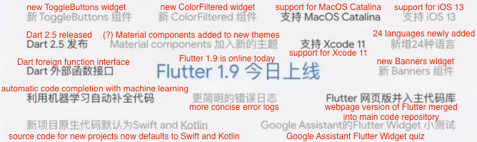
While browsing the Web, I came across this blog post, which announced a new version of Google's cross-platform Flutter framework.
My attention was seized by the image at the top, because there were Chinese words on the presenter's slide! As a little exercise, I annotated the image with English translations of the Chinese terms.
[2020-05-03: The picture below may be broken. It's a known issue as I work to improve the site for better display on small screens.]
Chinese-language version of conference slide announcing Flutter 1.9, with my translations superimposed.
As I watched a friend play the ninja videogame Sekiro: Shadows Die Twice, I noticed an inscription on an enemy samurai's war banner. I wrote it down; now I'm translating it.
有死之荣,无生之辱
Source and Translation
A rough translation of just this phrase is:
Having the honor of death, not the shame of life
This quotation comes from the Wuzi, a Chinese military classic by Wu Qi, a Legalist philosopher who lived during the Warring States period. He was a military leader in Wei and, later, a politician in Chu.
This is my translation of 《马裤先生》, by Lao She. The first draft was published on 2019-10-02. The second draft was published on 2019-10-04 (with thanks to Chris Stasse for some minor improvements.) Portions are marked if I'm still wrestling with them. I worked from the story as published in 《老舍小说集》 ("Collected Fiction of Lao She," ed. Fang Wei, China Society Press, 2004).
Translation
At Beijing Station, the train still had not set off. The man sharing my compartment, in the upper bunk, wore plain glass spectacles, a Western-style green satin shirt, and breeches. In his shirt pocket was a small writing brush; on his feet were dark woolen boots. The man asked, in a friendly manner, "Did you also board at Beijing?"