Two windows next to each other, one of which shows usage instances for the word under, or around, the cursor.
Part of the challenge of creating an interface to help with Chinese translation lies in defining the extent of a word. For example, when a verb and an object (e.g. 吃东西 ), is combined with a two-character complement (e.g. 起来), the result, 吃起东西来, does not contain "起来" as a substring, because two-character complements get split up to follow both verb and object. Any digital dictionary or reference system concerned with usage examples will have to account for this fact of Chinese grammar, and contain the knowledge that, despite the results of affixation, this can be considered an occurrence of the "起来" complement.
MacOS Chinese input allows you to cycle through the tones with TAB. I just discovered this after years of (begrudgingly) using this input method. Harrumph! They could have put the tones on the number keys to kill two birds with one stone:
Number -> tone is a straightforward, well-known mapping, so I wouldn't have had to discover this feature at random.
It would have forced them to find a smarter, more ergonomic way of letting me pick candidates, rather than having to lift my fingers from the letter keys to identify every single character I want to use.
There are Chinese characters which are structurally simple, but not in common use today.
A perfect example is 屾 shen1, a literary term which means "并列的两座山" ("two mountains side by side".) This is one of relatively few characters that is actually ideographic, i.e. has a shape depicting the real-world concept it represents. This is because 屾 shen1 is made up of two side-by-side copies of the character for mountain, 山 shan1. Two mountains side-by-side in the character; "two mountains side-by-side" for the meaning.
Below are other characters which have piqued my interest.
This is my translation of 《铁牛和病鸭》, by Lao She. The (rough) first draft was finished on 2020-02-15. The second draft was finished on 2020-03-04. Many thanks to Chris Stasse for helping me take this from rough draft to final version.
I chose to translate this story for the challenge of rendering the sections which deal with Sick Duck's mental landscape. As far as I am aware, I am the first person to have translated this story into English. It is not listed in the table of contents for Blades of Grass, nor in the contents of Crescent Moon and Other Stories; nor does the Modern Chinese Literature and Culture resource center list this story in its bibliography of English translations of Lao She.
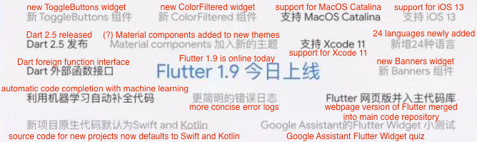
While browsing the Web, I came across this blog post, which announced a new version of Google's cross-platform Flutter framework.
My attention was seized by the image at the top, because there were Chinese words on the presenter's slide! As a little exercise, I annotated the image with English translations of the Chinese terms.
[2020-05-03: The picture below may be broken. It's a known issue as I work to improve the site for better display on small screens.]
Chinese-language version of conference slide announcing Flutter 1.9, with my translations superimposed.
As I watched a friend play the ninja videogame Sekiro: Shadows Die Twice, I noticed an inscription on an enemy samurai's war banner. I wrote it down; now I'm translating it.
有死之荣,无生之辱
Source and Translation
A rough translation of just this phrase is:
Having the honor of death, not the shame of life
This quotation comes from the Wuzi, a Chinese military classic by Wu Qi, a Legalist philosopher who lived during the Warring States period. He was a military leader in Wei and, later, a politician in Chu.
This is my translation of 《马裤先生》, by Lao She. The first draft was published on 2019-10-02. The second draft was published on 2019-10-04 (with thanks to Chris Stasse for some minor improvements.) Portions are marked if I'm still wrestling with them. I worked from the story as published in 《老舍小说集》 ("Collected Fiction of Lao She," ed. Fang Wei, China Society Press, 2004).
Translation
At Beijing Station, the train still had not set off. The man sharing my compartment, in the upper bunk, wore plain glass spectacles, a Western-style green satin shirt, and breeches. In his shirt pocket was a small writing brush; on his feet were dark woolen boots. The man asked, in a friendly manner, "Did you also board at Beijing?"