It seems that different preparations of rennet or different amounts of labor in the cheesemaking process can produce different types of cheeses. Such factors would be easy to add in for a little variety.
I choose Nagoya, for its location. It seems plausible that Port Tethys might control one end of the water corridor 0203-0303-0404, and Nagoya the other.
I'm tidying up notes from around my desk. This turns out to be my 50th post!
1.
Costs associated with getting your way. Spend points from (a pool based on ability)?
No. Very story-gamey. But, losing points from a pool which is based on your ability scores *is* fine, so that idea could be used for something. Suppose that if you have a Int/Con/other ability core of 15 that you also have a pool of 15 points which can sustain damage, similarly to HP.
(well actually that's very finicky. Revisiting this one a day later: I don't think I like it, but it's fod for thought.)
I want to say thank you very much for doing this particular post's worth of deconstruction (and for its follow-up, too.) I can see in it some of the failures that I experienced earlier this year while running my game. To be specific, instead of taking opportunities to hand my players the information they were clearly looking for, and put them in positions to act (or not) on that info, instead I drip-fed it to them at a rate which was too slow to maintain their interest. That was my fault.
Whoa! It'd be cool to figure out how taxation interacts with these calculations!
Imagine the total reduction in the size of the economy as calculated here.
Suppose 1 gp was added as tax per 100 lbs of iron ore sold in some region. Suppose a reference to iron ore is 1 ton, and this region has 5 references. Then 1 * 5 * 20 100-lb units per ton = 100 gp of taxes across all the iron ore here.
The recipe presented in the last post is of a small size. Many recipes require much more calculation than soap does (though recall that the definitions for the other recipes that go into it also required their own calculations.)
In this post I'll included screenshots of all of the calculations for the "hull, faering" recipe. I believe this is the largest recipe so far, both in terms of calculation and in number of sub-components.
A faering is a type of rowboat. Since this recipe only calculates the hull, the boat is not complete: there are no seats, no oarlocks, and no oars. Still, there's quite a lot to see, and I'm restricting myself to only those items which are directly being used in the faering hull. I'll show rivets, for example, which are made of copper, but I won't then go and show the copper recipe.
Here's a direction I'd like to see you take as part of this series: worked examples of encounters.
By that I mean, describe a scenario, and then what encounters you might produce based on (a) party interaction with environment and (b) what kind of of the 5 types you've established as being present here.
I don't think I've seen anyone do this kind of format before. And since here you discuss raising tension and affecting the feel of the game, which is something that other DMs haven't figured out yet, I think it would be useful to see transcribed your thought process while placing/choosing encounters.
Previous posts have addressed the establishment of references to raw materials ("mats") and to various types of artisan, craftsman, and laborer ("services") in the game world; the manner by which importing is done from city to city so that each one ends up with at least a little bit of everything, both mats and services; and how an increased distance from a source for a mat or service X lowers its availability and thus increases its price directly (mat) or increases the price of all goods which are created by a given type of worker (service.)
What we are still missing, however, are the components of the economy system which take us from the finished import step (where the relative availability of mats and services is known for each city) to the price tables which I have posted here (for the most recent version, see this page.)
As part of his latest post, Alexis challenges DMs to estimate how long they have spent working to become a DM. Below I do the calculations to estimate for myself how long I've spent actively DMing and working on the game.
I ran a bit on and off from 13 to 15 but none of it really stuck, so I won't count all that.
I'll start from 16 and my first group of serious players. At first I was running a group of 8 to 12, often one session Saturday and one Sunday with some players attending both games. I'll say each running was 5 hours, that's 10 hours per weekend for ... about 4 months, so 160 hours. Let's say prep work took half that amount of time spread out of the rest of the week, so multiply by 1.5 and we get 240 hours.
Forgive me for the lack of updates in the last two months. I've been preoccupied with finding work, my game has been on hiatus since June or so, and furthermore, because I was feeling a lack of direction in my projects, I gave myself permission to stop thinking about D&D entirely for as long as I needed to get my groove back.
A week or so ago, after a break of about forty days, I started working on D&D projects again. As my game will be starting up again soon, with a party partially or entirely composed of all-new players, I decided it was finally time to set my game in the real world.
The first time I read these lines by Borges, I thought of D&D:
"Through the years, a man peoples a space with images of provinces, kingdoms, mountains, bays, ships, islands, fishes, rooms, tools, stars, horses and people. Shortly before his death, he discovers that the patient labyrinth of lines traces the image of his own face."
Your sentence above -- "I wasn't making a world, I was making me" -- has a similar sentiment.
Nah, mang, mashups like this are an upside of basing your game on the real world. In the same vein I'm sure you've got something cool kicking around for the Illuminati, Rosicrucians, and Freemasons, which plucks from the real history of those organizations.
Alexis, for the pictures for each monster, have you considered using the graphics you've made to represent that monster on the combat map? Perhaps in addition to the other art you've sourced.
You've had nothing but hits in this series. I want to try these strategies and report back, to contribute to all of our understanding how to run a game on these principles, but my group is currently on hiatus for the summer. What do you recommend I do?
I'm having trouble getting what I want to say into words, but I'll try anyway
First I want to point out that some programming languages (and thus, games built with them) greatly reduce the amount of work required to edit and update the game as it goes. LISP, in particular, can have new code rewritten on the fly and added into the running program, with the new code used thereafter. While this still doesn't make it possible for a large game-design corporation to edit one's own particular copy of the game, it does mean that a solo hobbyist, running some kind of D&D world program, could fix small issues as they arise, or fix larger ones week-to-week just like writing rules in prose.
Solid thoughts on what factors of a game's design will make the game tough on players, and what it takes from the DM to present those elements every time they run. I haven't seen these concepts, or the inverse relationship, expressed anywhere else before.
What do you mean by "player confidence" at the end? Do you mean "player ability to understand what's going on in the game world [possibly as a result of their actions]?" The ability to distinguish the distinctions you wrote about above?
I'm glad that your conversation with Ryan bore fruit! I had a feeling you guys would connect.
You say that the difference between RPG design and Blow's videogame design is that Blow has to implement his thinking, his logic, in the medium of code, whereas once you conceive of something and can explain it, it is ready to be part of your RPG.
But what about all the rules which you write down, so that they are concrete, objective, and publicly visible? Is it not part of the natural life cycle of RPG content to be plucked from the DM's brain and codified?
I took apart Alexis generator and rewrote it such that each of details is more cleanly separated and the conditional logic is laid bare instead of hidden in nested IFs (no shame in Alexis doing it that way, it's how Excel works). I've been meaning to blog about it at www.blog.21stcenturydnd.com, but in the meantime mail me at maxwelljoslyn at gmail dot com if you'd like me to send you the files and a description. Could save you a fair bit of work. I'll include my additions too, as naturally I edited parts of it for my own game.
Today I upgraded the graphics of the GIMP image which I use as a combat map for D&D. Instead of the previous colored dots, I made blobby little avatars to represent the characters, and I drew depictions of all the weapons used by the current party and their hirelings, including dagger, shortsword, longsword, greatsword, bow, mace, and quarterstaff. I gave weapons to the characters whose weapon choices I know off the top of my head.
I also drew a hex-border with a blue and orange gradient. This is the casting indicator, to show that a character is casting a spell. That way, when someone announces they are casting, I can just flip the indicator's GIMP layer from hidden to shown. When they're done I hide it again.
I have a friend, Ryan, who studies the topic of play, from a literary-theory and videogames perspective, and who is currently in the works to publish the core of his thesis in an academic journal. Ryan is an active proponent of Bogost's work, among that of others.
I think the two of you could have a good conversation on the kind of topic you are writing about here. I've told him about you and he's read some of your blog, and he may even want to cite your blog in some future work. Would you like me to send an email introducing you two?
I'm noting that a mage could want to recreate all their X-level spells at their max possible spell power. For example, a 1st level mage would create a 1000 SP Magic Missile spell, with 3 Missiles from the beginning. Even if the wizard is higher level, it can be a boon for one's apprentice, and would very soon replace the Magic Missile spell.
The above is excerpted from Vlad Malkav's comment on my post about spellpower.
As usual, Vlad, you're asking good questions. You've raised an excellent criticism here.
Let's get one thing clear above all else: once spellpower and spell-creation rules are firmly in place, spell creation would absolutely not be available to first-level mages, as you indicate. Think of spell modification and creation as authority- or expert-tier abilities in Alexis's sage system. Maybe even sage-tier for spell creation: it's a big damn deal.
Today I spent several happy hours working away on adding tattoos to my economic system. Last session my players, having arrived in a port city, were excited (among many other things) about the possibility of finding a sailor who could give them some. Since I recently programmed the recipes needed to produce paper, I was already mentally ready to spend time work researching ink, so a lot of the time today was spent looking into pigments, binders, dyes, and mordants, and looking for historical information on the production of same. A good chunk of that time was spent looking in vain for some example ratios of pigment, binder, and water for pigment-based inks; in the end, for the red/yellow (both ochre) and blue inks, I had to guess.
One of the projects I plan to undertake -- though not at this time -- is to establish a method for quantifying spell effects (by number of targets affected, duration, magnitude of damage or other effect, range at which spell can be cast, and so on) and apply this method to the existing spells. I want to do this so I can compare the relative strength of spells currently considered to be the same spell level. Let's call this quantified spell strength "spellpower."
Once I can perform such a comparison, I can set quantities of spellpower which mark the border between first- and second-level spells, second- and third-level spells, and so on.
OK. I say add a sentence to the end of the paragraph beginning "effectively" which makes that point in terms of line of sight.
Does the -4 AC penalty apply only against the targeted enemy, or against any attack made against the shooter in the following round? (I'd assume the latter, given that the target of the shot would be some distance away.)
Does sighting cost AP?
What happens if I sight a guy, and between sighting and firing he has moved (meaning I only have a chance to hit on a 2, and even then only if he's in the 30-degree cone), but then I roll a 20 on the attack roll? Critical miss? :P
Setting aside the -1 hit penalty, the natural 2 quirk, and the -4 AC vs the targeted enemy, the main benefit is supposed to be that you can load a bow for firing at a given enemy despite currently being behind cover (and thus not having line of sight), correct?
The question of digital character sheets is kicking my ass. Modeling a character as a chunk of data: sure, no problem, I can do that in any language I care to use. The GUI part is all-new to me, but I have at least a stopgap solution for use with Python, the language I am currently coding in.
But the live-update part? That's trickier. I have an idea formulated which I'll code up soon, maybe later today, but for now it remains larval.
In the mean time, I can talk about what I did work on today. I fixed some issues with the pricing of alcoholic goods (so far: beer, ale, and rum) in my recipe system.
You bring up the fact that high level players wouldn't care about the available bonus XP for art anymore. That may be true, but consider also that players looking to gain extra XP for their lower level followers and henches could do worse than a sightseeing tour in a large city. Nice dollop of XP for the henches to start off a level without having to take them into the kind of fights that high levels get into (which probably have a high mortality rate for lowbies.)
The project I am currently planning can be broken down into several iterations on the same theme. I'll try and break it down here, noting that this is not a finalized roadmap, just my current headspace. There's bound to be some overlap and messiness as I sort these concepts out.
Digital Representation
Player characters are represented in a digital format. I do generate character background with a program which takes the six ability scores, sex, and character class as input; however, the generated info is then printed onto paper and used as a supplement to the character sheet, so it doesn't remain digital. Note that for this stage I am only talking about a computational object which represents the character.
After a year of work, I am happy to say that this week I successfully defended my thesis. In my research I was primarily concerned with gathering empirical data regarding a particular question construction in Mandarin Chinese, and the results of my collections show the necessity of expanding current syntactic theories regarding this type of question.
Yesss, the mustard post! When I showed your blog to my best friend and fellow game designer, I used that one. If I have more such opportunities I'll use it again. I think it is a very strong description of what D&D can be when you get past all the bland Saturday morning cartoon hero crap. It's also an endorsement for having systems like the economy in place to drive this kind of engagement with the consequences of being in a specific place.
Oh, I see. It's not that you're defining an additional status between combat-trained and 1st level, it's that you're coming up with an idea to parcel out the 1st level abilities, so that they can be incrementally gained. And if you can gain them all, then that's the very definition of 1st level. Not getting them all means never making 1st level but you've still got more training than the average combat-trained dude.
Perhaps the prime requisite for the class in which the trainee is acquiring skills, could be the die roll to see if each bit of training takes hold. Or perhaps Intelligence needs its day in the sun.
Another possible option for expert instructors could be the ability to train multi-classed persons (or at least train the appropriate portion of their training.)
So the current state of the proposal, for fighters at least, is:
a fighter with Amateur status in Instruction can, by fighting alongside a trainee, improve them to combat-trained (gaining the benefits of not needing morale to enter combat, better morale score, and first weapon proficiency)
a fighter with Amateur status can further improve a combat-trained person part of the way to first level, but not all the way (extent possible is TBD.)
an Authority in Instruction can take the combat-trained person all the way to first level (or take them from partly trained to first level, if someone has already trained them part way)
On a different note, I dig the scraggliness and irregularity of the barman's hair, including the bald spots, and the off-color lines giving depth to the hair of both characters.
Likewise, good attention to detail with the rag moving back and forth between panels, including the pause during the beat panel. From this and the guy moving back in his chair in comic 7, it's clear you have a grasp on implying motion. (maybe that skill got beefed up drawing hundreds of combats and keeping track of thousands of people and objects within them.)
It looks like the body of the tankard of beer (the part that's not the handle) was drawn by doing a gray-gold gradient across a circle shape. The problem with that is that there's no distinction between the tankard and the beer; it's just the two colors mixed together. Fixing that should avoid the lollipop look. Try a gray rim and then fill the inside with gold only, i.e. a circle in a circle, the outer one gray, the inner one gold.
The above might require making the tankard a bit larger to get the effects across, but it may be that once the container and its contents are visually differentiated, the contrast will be stark enough to stand out even at small sizes.
I catch up the Juvenis campaign in bursts. Just read the latest posts yesterday, since I wanted to see what was up with the room beyond the statues.
The most recent "I have learned something from reading" moment was when you reminded whoever that they could see their javelin. I'll write a note reminding myself to focus harder on character sensation and perception, both in exploration and in combat (having had good results after your advice to emphasize inputs other than "what they see" and "what they're told.") I keep forgetting to do non-visual stuff but it'll come.
I'm digging the foray into modern character design -- maybe a bit less tedious to draw than with all those medieval fiddly bits, huh?
The first panel's dialogue was hard to read because it flows counter-clockwise and from the right. Obviously it wasn't a brainbuster, once you read all the lines it's obvious how to read them, but it felt weird at first. Natural inclination to scan comics in columns: left-top, left-bot, mid-top, mid-bot, right-top, right-bot.
Please find a little time before Sunday night to look at the page appropriate to your character class, browse the fields and studies there, and think about what sounds good.
A "field" is a grouping of studies: for example, the druid has the fields of Animal Life, Earth & Sky, and Plant Life. A "study" is an area of knowledge containing multiple different skills, which can be gained one by one as the character gains knowledge points. For example, the druid field of Animal Life contains the studies Amphibians and Reptiles, Birds, Bugs and Spiders, Golems, Mammals, Sea Life, and Slime Molds.
Tim makes a good point about higher level monks (and to a lesser degree anyone with Puissance skills which I expect will be similar in concept to these if not in effect) having a lot of combat options. But spell casters have dealt with that forever and been just fine, so I expect it's no problem.
I forgot to mention I especially like the techniques which allow additional special actions after a stun. That's a very solid concept, and I could see it being reused in certain Puissance abilities.
Really cool, Alexis, really really cool. How excited you must be to finally be laying out the monk! The abilities seem nice and gradual, situational. Nothing jumps out as overpowered or too elaborate. Let's see how playtesting goes -- I don't remember, are you currently running your offline party with the monk in it?
I was sitting at a hundred and ninety-something recipes in the trade program for a week or two until this week, when I hunkered down and added some things which I'd had to make up ad-hoc weights for last time. Now I am past 200 items inside the table's workings, which is the milestone I set myself for making this post.
So: here is the current trade table, for the market town nearest to the party. (I've also attached screenshots of the version at the bottom of this post.)
I'm finishing up adding a wooden ladder to my price table. Sounds simple, right? Have a look at my thought process below, to see what I think about when I add something to the table.
I'm modeling each rung as a carved cylinder of diameter 1.5 inch and length 1 foot.
This is just a plain old straight ladder, so the side pieces are two long planks. I've got them here as 17 feet long each, with width and depth both 2 inches. Distance between rungs is 1.5 feet, so that's ten rungs plus a foot of extra at the top and bottom.
I'd say "quite a new direction for the Tao," but actually the comic format seems a natural progression given all the work you've put into character and environment art. Has potential.
A bit of criticism: I think the dialogue would work better if the DM's drone continued through onto the beat panel. The guy with the metal shield says "it could be important" in panel 2 and then the DM provides a counterpoint by going into even more pointless details than the bits of iron. Then, when you cut out the DM dialogue entirely in the final panel, it's even more obvious that he's just background noise and the players have stopped caring -- reinforcing the "start a campaign" dialogue.
As of last session I have finally gotten the hang of drawing a map on the computer during play. I've resolved to continue doing this as it's much cleaner and quicker than using pencil and paper, and makes it easy to move things around or copy them when needed.
Perhaps you could put a page on the wiki with a line for each chapter saying DONE, NEAR-DONE, MESSY, or WHATEVER states you feel are appropriate.
You could also have, on that page, a series of lines with the date, and then the word count at the end of that day. I know word count is an ambiguous measure -- often the writer's job is to throw things out because they don't fit, or tighten them up so they're less verbose -- but then we'd at least see the ups and downs. I always find it helpful to put a number on something, even if it's not a perfect measure.
I did some good D&D work today. I added the coat of plates to my economy program, which achieved a few intertwined goals all at once:
write economy recipes for every armor type
restyle the traditional range of armor scores (9-3) with terminology I find more satisfying (see below) the armors while retaining the conceptual and linguistic shorthand categories of "leather/mail/plate"
These are the divisions of armor types which I've arrived at:
quilted gambeson (which must be worn under other armors, too)
leather armor
coat of plates
haubergeon
hauberk
half-plate (breastplate plus assorted arm armor)
full-plate (as half-plate plus fauld and leg armor).
Having taken Alexis's DMing master-classes last fall, and having been back in the DM saddle for nigh on half a year now (after three years of absence), I've been working hard to shore up my weaknesses. Both the classes and my new influx of practical experience have shown that one of my weaknesses is hesitation. Just plain difficulty with making a decision quickly.
In order to combat this, and in order to get some more experience with performance (which is part of what a DM does), I've signed up for and begun taking comedy improv classes at a local theater. The course runs for two months and next week will mark the halfway point.
Certainly a thinking player can find all kinds of ways to combine the capabilities granted by their studies: being stealthier or more sure-footed will expand the places in which one could set a trap, for instance.
When I said "benefits in all other areas" I was referring to upgrades like "Creativity + Performance does not increase the poet's repertoire, but it increases the level of the performance, changing that 1% x.p. bonus to 2%." I don't remember reading these kinds of crossover benefits between studies in your previous material. But, point taken: maybe I'm being myopic by only asking about effects from one study on another. What does it matter what part of the rules a sage study tweaks, whether it is HP recovered from resting (Medicine - Aid Rest) or attack rolls (Puissance - something) or another study outright (Creativity boosting Performance)?
So there's a lot of crossover between artistic studies for the bard, unlike for the other classes. Which on the one hand means it takes a long time to "unlock" all the combinations of various studies at various levels, but on the other hand means that often a new level of ability in one area of artistry will mean benefits in all the other areas, too. That would be a lot of fun as a player: "look, getting a bonus in such and such means all this other stuff starts to work better too."
I was texting with a player of mine today after they had let me know they'd be unable to come to the game this evening. They recalled that they had been laid out unconscious by a bear's paw in the previous session, a few weeks ago when we last played before the holidays.
Then they said to me something like "I guess I'll see if I have any possessions left when I return."
This struck me as odd, so I asked whether they were used to other players taking their stuff when unconscious. The player's response, paraphrased: "No, but we aren't exactly scrupulous people, and in character there's not much reason for loyalty or camaraderie." Emphasis mine.
Imagine the bard toiling for weeks and months to accrue 50 bard points which are to be spent to make a planned architectural project properly strike people with awe when viewed.
That makes me think of alchemy, or breeding monsters per your rules, or planting and sowing crops. Long term effort, guaranteed reward. Perhaps on the one hand the bard doesn't have guaranteed success -- there's also a chance element involved in successfully moving one's audience -- but on the other hand, as an artist may get nowhere with one work only to return to its principles later, the bard may be able to start from a position further along than 0 when trying again at the same type of project.
Perhaps we can turn this latest idea on its head to remove the rankle factor.
Suppose instead that bardic performance abilities charge up a (small, capped) pool of points, which might be used by the bard when needed to remove a point of damage here, wipe away a bit of stat penalty from the day's travel there? On self or on others, naturally.
Or there's another implementation: the pool of points (let's call them inspiration points) recharges in some way, and bardic performance discharges them to produce effects. Perhaps the pool replenishes from drinking booze, as you've put forth previously.
Well, what are the real-world failures an artist can experience?
Having a novel vision but lacking an appreciative audience or patron is a failure to find the right people, but not a failure of the art itself.
Having a novel idea but being unable to express it concretely as an art work ... that's definitely a failure, although this kind of "failure" is often temporary and is usually experienced by the artist as spinning one's wheels. Approaching success through approximations to what is ultimately the "final" work.
When you put like that, yeah, I see how what I was saying is on the same continuum as twerpy DMs who make bard players sing/dance/act in order to trigger their effects. Point taken.
Oh oh: however misguided, one thing the idea I posted does get right is the player being inspired by something, and then working to make it a (game) reality. Sort of like the real art process in miniature.
A possible flaw: to enjoy picking pieces of art and trying to come up with gamified versions of them requires a player who is already artistically inclined.
A counterpoint: is it so bad to ask that a player who wants to play an artist put in a little legwork to form a personal sense of artistic style? At first blush it seems wrong. There's no such stricture for other classes: a player not inclined to be violent in real life can derive terrific joy from playing a fighter or assassin.
Upon reading your line about the player "getting to be an artist" by playing a bard, I had the idea of the player being able to pick a piece of art -- an image from google search, or a musical piece, or whatever is appropriate to the character's art specialty -- and working with the DM, and under limits related to size, complexity, etc., translate that art piece into a form the character can actually produce.
I don't think that's the right track at all, but it came to mind.
what it means to succeed as a bard, i.e. an artist? It's not just fame.
how can we turn whatever-artistic-success-is into a playable concept?
Hmm ... if fame is the wrong thing to measure for bardic success, maybe we can get somewhere by considering that each class (in your rules) has ways to influence others.
Torture and murder for the assassin; theft and the consequent disruption of others' economic affairs for the thief; preaching to incite reactions, as well as being crucial to the community's physical/mental wellbeing, for the cleric; magical prowess and potency for the mage; skill at arms and at leading men for the fighter. What can the bard gain along these lines?
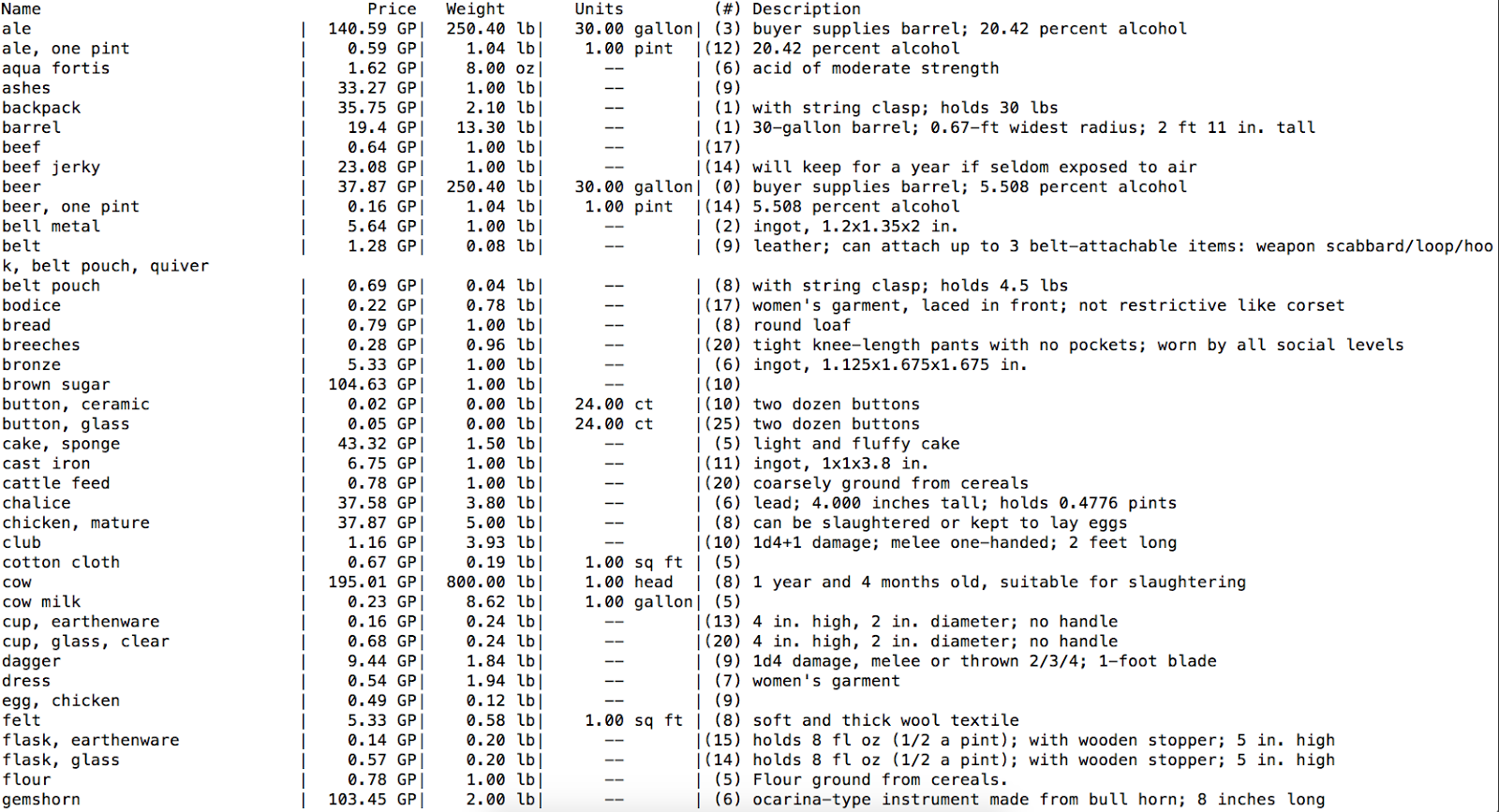
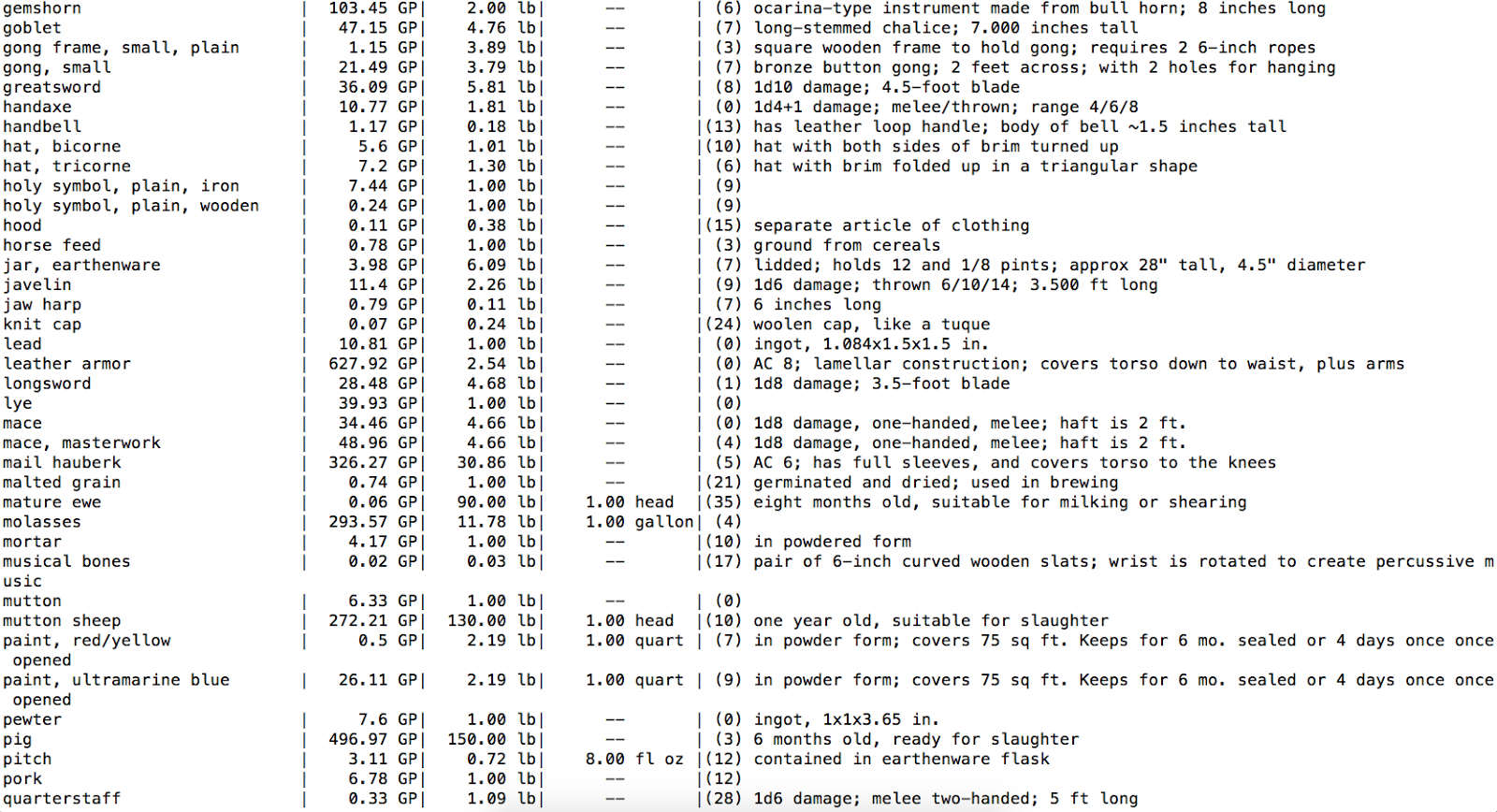
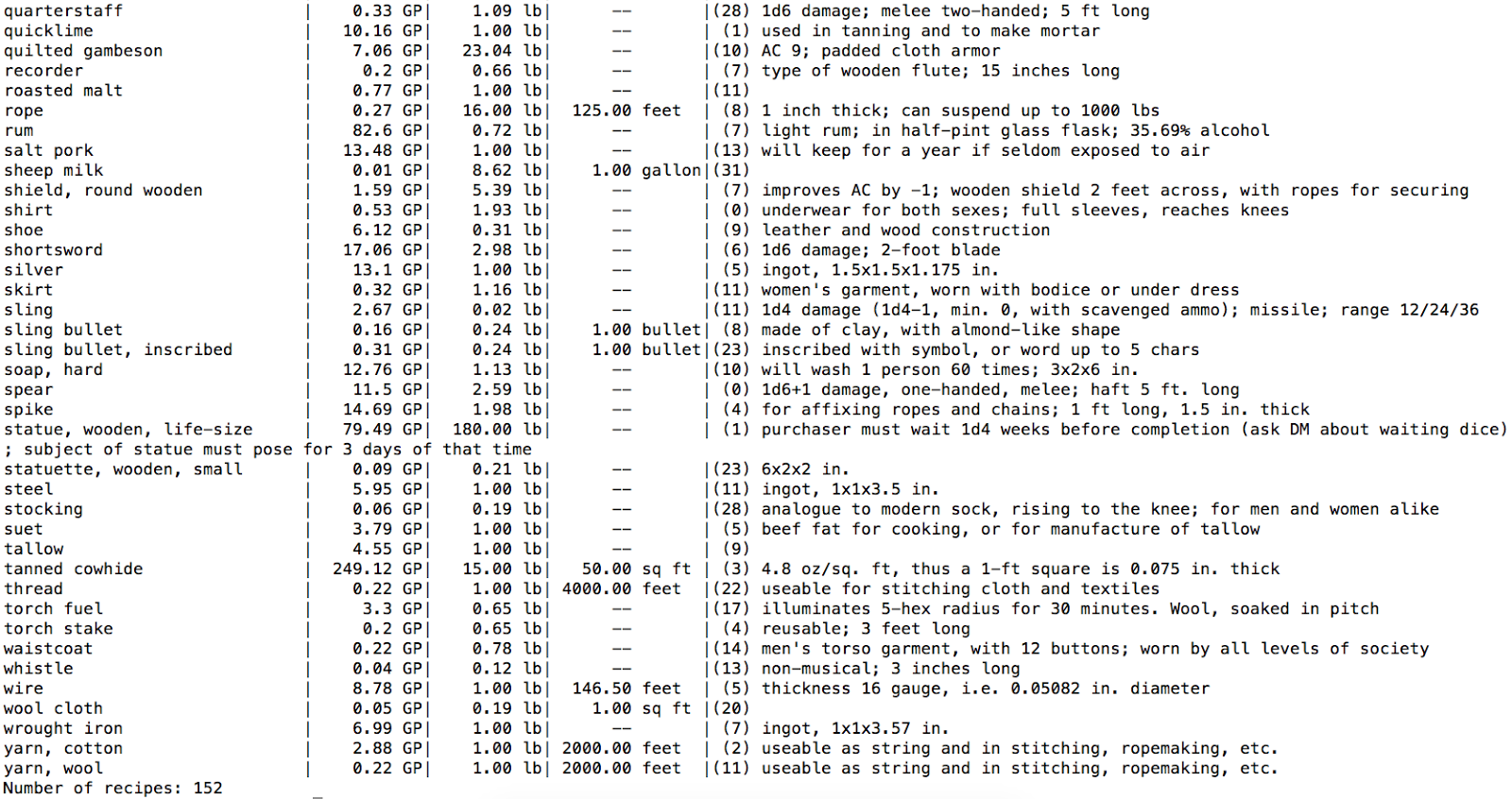
This post is quite simple. In the six months since I began this blog I've slowly added items to the trade table I wrote about in the very first post. Recently, I reached and then surpassed 148 items, which is a milestone because it's double the number of items in the original posting.
To celebrate, here is the table as it stands. The pretty version is buggy right now, unfortunately, so this is the less-pretty version. If you are having trouble reading them, click the images for full size.